Grok Bot for GTM and Sales: The Working Setup (2026)
How GTM teams actually run Grok Bot: the SpaceXAI insider's ten-Bot roster, the two Bots to build first, the prospecting and lead-finding mechanics with receipts, the approval rules that keep it safe, and what a sales pod costs.
GTM is the one function where Grok Bot has a published setup from inside SpaceXAI itself: Krista Letz runs enterprise go-to-market there on a roster of about ten Bots, and both her X Article and the official guides library describe it. This page turns that insider account, plus the four independent builder posts with actual pipeline mechanics, into something you can build: the roster, the two Bots to start with, the outbound rules that keep it from damaging your domain and your pipeline, and what it costs to run.
If you have not set up Grok Bot at all yet, start with the guide; this page assumes the basics (Bots, the shared computer, Routines, approvals).
The insider's roster
Krista's team, as her article describes it. She is a SpaceXAI insider dogfooding her employer's product, so read this as the ceiling of what the vendor's own power user runs, not a starting point; her article shows the roster and connector screenshots and describes the workflows rather than walking through runs.
| Bot | The job, in her words |
|---|---|
| Chief of Staff (pinned) | "My Chief of Staff owns meeting prep, inbox and post-call drafts, orchestrates the rest of the team." Runs the daily meeting-prep workflow: pulls from Salesforce, Gmail, Slack, Granola, Gong, or online research, output short enough to skim on a phone |
| Prospecting Bot | Pipeline-generation plans, intent data, deep research (webinars, podcasts, blog posts, LinkedIn, X), drafts in Gmail in her voice. "I like to run this overnight" |
| Customer expert | "One agent per strategic account (works for top prospects too)": watches the account's Slack channels, digests calls, emails, and threads, flags feature requests and support tickets, runs a weekly media rundown |
| Forecasting Bot | Pulls Granola, Gong, Slack, and email, "auto updates Salesforce opportunity notes" in a set format |
| Data analysis Bot | Usage data across her book of accounts |
| Product expert | Connected to the codebase (Glean as the alternative source if you cannot get repo access) |
| Slides Bot | Owns customer decks in Figma with the brand system; per-customer copies; can update a deck live from a Granola transcript mid-call |
| Sales Coach | Watches Gong calls, gives feedback |
| 1:1 Bot | Preps her weekly manager sync from Granola |
Connectors behind all of that: Salesforce, Gmail, Calendar, Sheets, Drive, Slack, Notion, Granola, Gong, Figma, X, LinkedIn, and "your data warehouse".
Three of her habits matter more than the roster size, because every good GTM setup we read repeats them:
- Voice first. Before any Bot drafts anything: "Ask bot to scan your gmail and slack for how you write... Have it scan your sent mail and build a style profile before it drafts anything." She keeps an anti-slop skill and adds to it every time she corrects the Bot.
- Teach by demonstration. A workflow that lives in your clicks (a CRM update path, a list build) gets recorded once with teach-a-task and becomes a skill.
- Audit the roster. Periodically ask the chief of staff to look across every Bot and routine, propose what to automate or parallelize, and "clean up unnecessary routines." Rosters rot; hers has a Bot-facing janitor.
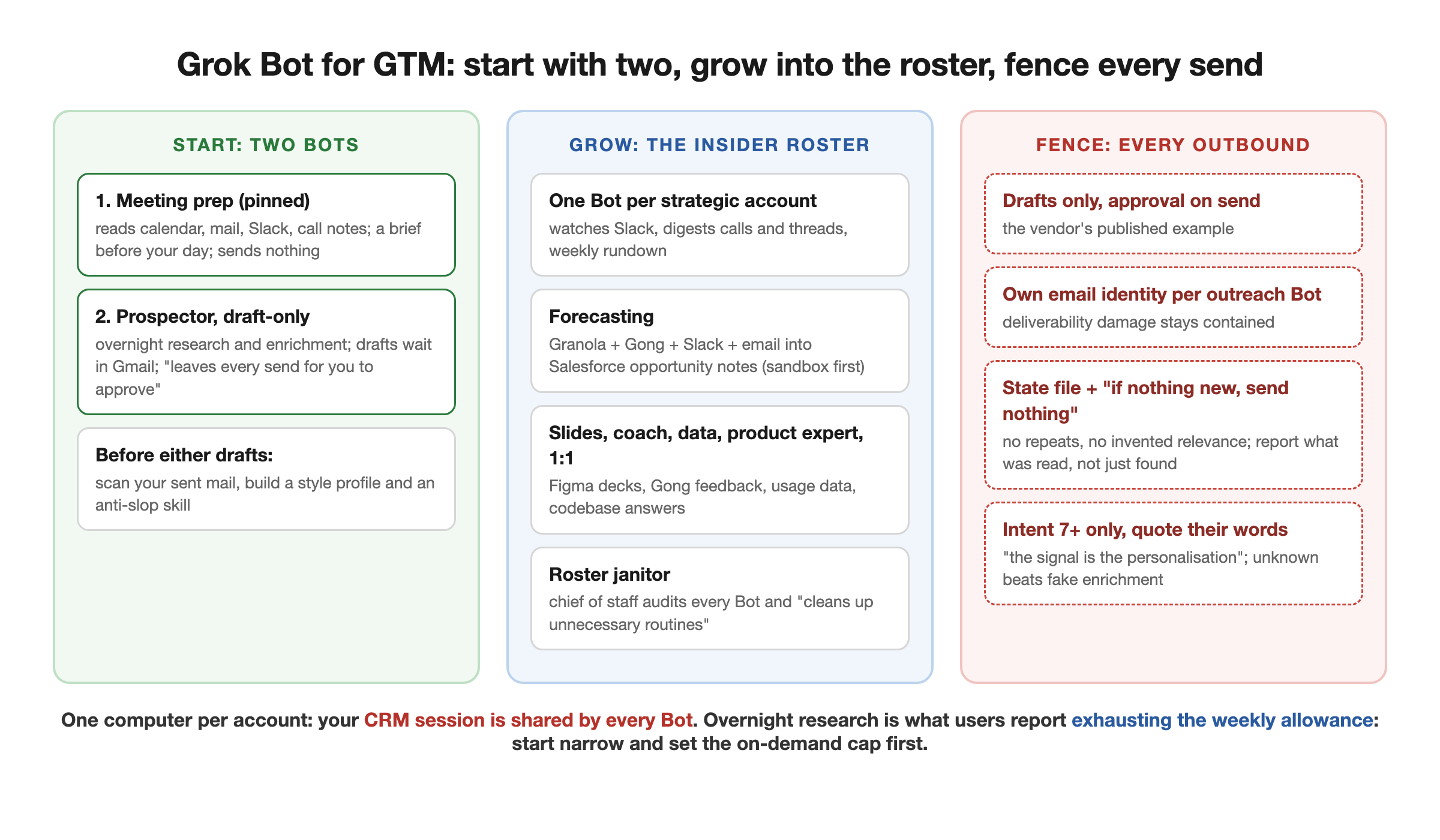
Start with two Bots, not ten
Ten Bots is an insider dogfooding her employer's product. The published playbooks from people who pay for it converge on starting small (our AI team guide has the roster-size evidence). For GTM specifically, two Bots cover most of the value:
Bot one: meeting prep. The highest-frequency, lowest-risk job in the roster, and the one Krista pinned. Give it read access to calendar, mail, Slack, and your call-notes tool, and a routine before your working day: for each external meeting today, who they are, what changed since last touch, what was promised, three things to say. It sends nothing by design; still state that boundary explicitly in its description, connect only the tools it needs, and start it on read-only tasks, per the approvals documentation's least-privilege advice. You will know within a week whether the briefs are good.
Bot two: the prospector, draft-only. SpaceXAI's own canonical example: "Researches and enriches accounts, drafts personalized outreach. Leaves every send for you to approve." Run it overnight like Krista does, but adopt the discipline the solo-founder playbook wrote down, whose rules are built against the two failure modes its author reports in scheduled research Bots, repeating themselves and inventing relevance:
- Interview once: your ICP, three competitors, the problem in a customer's words, where your buyers talk.
- Keep a state file of every account and post already reported; "never report the same thread twice."
- "If nothing new, send nothing." A quiet morning is a correct output.
- Drafts only. Never send, never promise price or roadmap.
Add specialists only when one of these two Bots keeps hitting a wall that a distinct role, with distinct tools, would remove. That is the same build order as any agent team: specialist, then memory, then more specialists, coordinator last.
Free AI Builder Newsletter
Weekly guides on AI tools & builder strategies.
The pipeline mechanics people have actually published
Four mechanisms circulate with enough detail to implement. Evidence levels vary, and we state them.
Complaint-search lead finding. Luis Batalha's loop: have the Bot search X for people describing your problem or complaining about a competitor ("looking for an alternative to..."), enrich the poster and their company through a connector, then reach out to the poster and the commenters, and "turn it into a Grok Bot routine so you get these buying signals every week." His one-line justification is the best argument for the whole category: "you don't need to guess whether someone has the problem you're solving. They just publicly told you they do." Mechanism described, no results shown. If your Bots read X, know that the official X connector creates a developer account with included API credits for paid users, and that one builder reports the Bot says "nothing new" rather than erroring when those credits run out, which a state file makes indistinguishable from a quiet week. Check the credit balance when the miner goes quiet.
Intent scoring before outreach. The buyer-intent spec adds the filter that keeps the complaint loop from spamming: score each signal 1 to 10 (10: asking what to buy; 8: comparing options; 7: a strong complaint from a relevant buyer; 5: mentions the problem; below 5: ignore), only surface 7 and up, and record every lead in a fixed 12-field format with the source post URL and the exact problem quoted. Its two rules are worth pasting into any prospector's description verbatim: "if something cannot be verified, write Unknown" (fake enrichment is worse than a gap), and dedup on person plus signal. It is a spec, not a run log, and it is tool-agnostic; the author describes it for both Grok Bot and self-hosted agents.
Signup follow-up. One SaaS founder's flow: every registration that does not convert lands in a Slack channel; the Bot picks it up, finds the person on LinkedIn, researches the person and company, and adds them to a personalised sequence, with a one-line call opener written for the rep when the company is big enough to phone. Two caveats: the sequencing runs through an MCP the author himself sells, so it is a vendor demo of a real pattern; and the pattern itself, signup event to researched draft, transfers to whatever sequencer you already use.
The outreach rules. The official prospector example and the draft-only playbooks cited here converge on the same fences, and they are the difference between a pipeline asset and a spam machine: give the outreach Bot its own email identity rather than yours, so deliverability damage is contained and the Bot "joins your tools as itself" (one real-estate operator reports doing this at 100-message-a-day scale, with no artifacts shown, and it matches the third-party mailbox pattern in the wider corpus); keep drafts short with one observation and one ask; quote the prospect's own words, because, as the buyer-intent spec puts it, "the signal is the personalisation"; and put every send behind approval, matching SpaceXAI's published prospector example. The documentation's version of the same idea: put standing boundaries in the Bot's description and add narrow Require Approval rules for sending and publishing.
What can go wrong, specifically for GTM
- Your CRM login is shared by every Bot. One computer per account: a Salesforce session the forecasting Bot opened is available to the prospector and everything else. "Do not use separate Bots as a security boundary" is the documentation's own line. A separate Bot is not enough isolation: if an experiment should not be able to touch your pipeline, keep the CRM session and connector off that account entirely, or scope it to a separate service account or a different Grok Bot account.
- A write-to-CRM routine needs a sandbox first. The insider's forecasting Bot auto-updates opportunity notes; that is her description of a mature setup inside the vendor. Start yours on a test opportunity, review a week of its notes, then widen.
- Overnight research can consume the weekly allowance. xAI does not publish per-workload consumption, so treat this as the user-reported pattern it is: start the prospector narrow, watch the meter for a week, and set the account-level on-demand cap before the first overnight run if you enable overage. The pricing page covers the meter, the reset, and the tactics (business-hours scopes, event triggers).
- Quiet failures look like quiet markets. Two user-reported silent modes, neither reproduced by us: exhausted X credits reporting "nothing new," and a scraper surviving a site redesign by happily reporting empty scans. Both hit prospecting Bots hardest, because their success state is often nothing today. Make the routine report what it read, not just what it found.
What it costs
No GTM-specific pricing exists. Per person: a Cursor plan from 20 dollars a month or a SuperGrok plan from 30 includes Grok Bot with a weekly allowance; self-serve Cursor Teams seats (40 Standard, 120 Premium per user) include it for every member with admin controls, MCP allowlists, and team rules, which is the shape a sales team actually wants. Enrichment, sequencing, and CRM seats bill separately, and if you want each Bot as its own identity in those tools, those are extra seats too. The full plan table and the limit-burn tactics are on the pricing page.
The shape underneath
Strip the product names and the insider's GTM stack is the same architecture as every working agent team: narrow specialists, state kept where the next run can read it, a human at every send, and a coordinator that routes instead of doing. That pattern, and the build order that gets you there without a graveyard of abandoned Bots, is How to Build an AI Team; the single unit under all of it, one agent on a schedule behind a quality gate, is what the Loop Engineering course builds, on Grok Bot or any harness you own.
Related Content
- How to Use Grok Bot - Setup, the shared computer, the use-case ledger, and the limit tactics this page assumes.
- How to Build an AI Team - The roster-size evidence and the build order the two-Bot start follows.
- Grok Bot Pricing and Usage Limits - What the plans cost and how an overnight prospector interacts with the weekly meter.
- Grok Bot Templates - How a tuned GTM roster becomes a one-click install, and how to vet one.
- Who Owns Your AI Agents - Credentials and offboarding for Bots with CRM access.
Frequently Asked Questions
Can Grok Bot do sales prospecting?
Yes, and it is the use case SpaceXAI itself leads with: its access-expansion post describes a sales prospector Bot that researches and enriches accounts, drafts personalized outreach, and leaves every send for you to approve. The insider GTM guide says she likes to run her prospecting Bot overnight: pipeline-generation plans, intent data, deep research across webinars, podcasts, blogs, LinkedIn and X, with drafts waiting in Gmail in the morning. Note what both descriptions share: the Bot drafts, a person sends.
Can Grok Bot update Salesforce?
The insider account says yes in two places: Salesforce is first in her connector list, and her forecasting Bot pulls from Granola, Gong, Slack, and email, then auto-updates Salesforce opportunity notes in a set format. That is her description of her own setup rather than a documented product guarantee, so treat it as an insider report: connect Salesforce through the Plugins surface and test on a sandbox opportunity before letting a routine write to your pipeline.
Should a Grok Bot send cold outreach on its own?
No. SpaceXAI's own prospector example leaves every send for approval, the lead-finding playbooks cited here run draft-only Bots, and the documentation recommends narrow Require Approval rules for sending; nothing we read argues otherwise. The practical rules that recur: outreach drafts only, quote the prospect's exact words rather than paraphrasing them into marketing language, keep it short with one observation and one ask, and give the Bot its own email identity so a bad sequence cannot burn your personal sender reputation.
What does Grok Bot cost for a sales team?
There is no separate GTM price. Each person needs a plan that includes Grok Bot: individual Cursor plans from 20 dollars a month or SuperGrok plans from 30, and self-serve Cursor Teams seats at 40 (Standard) or 120 (Premium) per user with team admin controls. Every plan carries a weekly usage allowance of unpublished size; xAI does not publish what drives consumption, and an overnight prospecting routine is the kind of work users most often report exhausting it, so start narrow, watch the meter, and read our pricing page's limit tactics before you schedule anything. Tools your Bots sign into, like your CRM and enrichment products, bill their own seats on top.
Is Grok Bot better than dedicated sales tools?
It is a different layer. Dedicated tools own one step well: enrichment, sequencing, call recording. Grok Bot's value in the published GTM setups is the connective work between them: reading Granola and Gong and Slack before a call, moving what was said into Salesforce notes, watching accounts, and drafting in your voice. The working setups keep the dedicated tools and let Bots operate them through connectors or the browser, rather than replacing them.
Sources & Verification
The roster comes from the one person who has published a real GTM setup from inside SpaceXAI, Krista Letz, via her X Article and the official Grok Bot GTM guide, both read in full on 2026-08-30; her workflow descriptions are an insider's account, and we label which parts her article demonstrates versus describes. The pipeline mechanics come from four independent builder posts, each linked where used, with the evidence level stated (one author is the vendor of the MCP he recommends, and we say so). Product behavior (approvals, the shared computer, routines) is checked against docs.x.ai. We have not run this GTM stack ourselves; this is a synthesis of documented usage with the safety rules the documentation and the builders agree on. See our editorial standards.
- Grok Bot for GTM (Krista Letz, SpaceXAI, X Article, 2026-08-16) - The insider roster this page is built from: a pinned chief of staff plus about nine specialists, the connector list, the overnight prospecting run, and the style-profile-from-sent-mail step
- Grok Bot for GTM (official guide, x.ai, 2026-08-16) - The official version of the same material in SpaceXAI's guides library
- Grok Bot is now included with more plans (SpaceXAI, 2026-08-26) - The official sales-prospector example: 'Researches and enriches accounts, drafts personalized outreach. Leaves every send for you to approve'
- Grok Bot FAQ (docs.x.ai) - One computer per account shared by all Bots; 'Do not use separate Bots as a security boundary'
- Approvals, security, and privacy (docs.x.ai) - Standing boundaries in the Bot description, narrow Require Approval rules for sending and publishing, least privilege
- Grok Bot now works with X (SpaceXAI, 2026-08-29) - 'Paid Grok Bot users get free X API credits to start'; the connector auto-creates a developer account
- Finding customers from competitor complaints on X (Luis Batalha, 2026-08-25) - The complaint-search lead loop: search X for 'looking for an alternative to', enrich, reach out, save as a weekly routine. 4.6M views; mechanism described, no results shown
- SaaS signup follow-up through Grok Bot (Pierre-Eliott Lallemant, 2026-08-28) - Non-converting signups from Slack to researched, personalised outreach. The author founded the MCP product in the loop, so this is a vendor's account of his own stack
- How to build an agent that finds you customers (hooeem, X Article, 2026-08-27) - The buyer-intent spec: a 10-point intent ladder, a 12-field lead record, a seen-leads dedup file, and the 'unknown is better than fake enrichment' rule
- How to Build the Best Team for Solo Founders in Grok Bot (Paul Klay, X Article, 2026-08-29) - The Signal Miner prompt this page's outbound rules borrow: state file, 'never report the same thread twice', 'if nothing new, send nothing', drafts only
- Real estate deal flow on Grok Bot (Cole Ruud-Johnson, 2026-08-27) - The own-email-identity pattern for an outreach Bot working a pipeline; a first-person account, no artifacts shown
- How to Use Grok Bot (AI Builder Club) - Setup, the shared computer, the use-case ledger, and the usage-limit tactics this page assumes
- Grok Bot Pricing and Usage Limits (AI Builder Club) - What the plans cost and how the weekly meter behaves under an overnight prospecting routine
Join AI Builder Club


$37/mo
Get the free newsletter
Weekly deep-dives on AI tools, automation workflows, and builder strategies. Join 5,000+ readers.
No spam. Unsubscribe anytime.