Best Claude Code Courses in 2026 (Free + Paid, Compared)
The 6 best Claude Code courses in 2026, compared: Anthropic's free courses, the Coursera Vanderbilt course, AI Builder Club's Claude Code 101, and more.
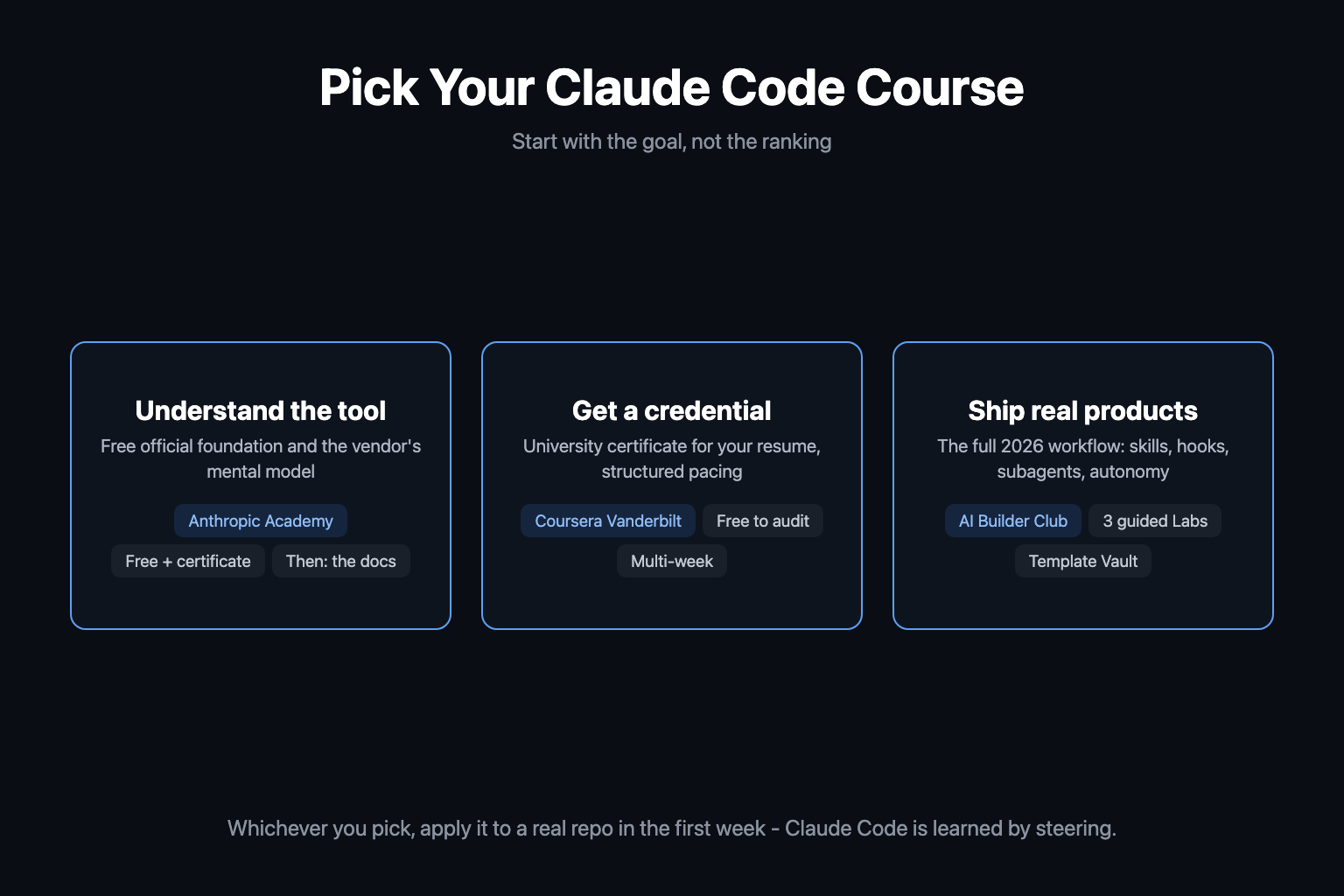
The best Claude Code course in 2026 depends on one question: do you want to understand the tool, get a credential, or ship products with it? Anthropic's free official courses are the best foundation, Coursera's Vanderbilt course is the best university certificate, and our own Claude Code 101 is built for the third goal - shipping. This guide compares all the serious options honestly, including where each one falls short.
One disclosure up front: AI Builder Club is our platform, so one of the entries below is ours. We've compared it on the same criteria as everything else and told you exactly who should not buy it.
The Short Version
| Course | Price | Length | Certificate | Best for |
|---|---|---|---|---|
| Anthropic Academy: Claude Code in Action | Free | ~2-4h | Yes (official) | Free official foundation |
| Anthropic Academy: Claude Code 101 | Free | ~2h | Yes (official) | Complete beginners to coding agents |
| Coursera: Claude Code (Vanderbilt) | Free to audit; cert via subscription | A few weeks part-time | Yes (university) | A resume credential |
| AI Builder Club: Claude Code 101 | Membership | 7h+, 27 lessons | No | Shipping real products with the 2026 workflow |
| Free YouTube full courses | Free | 1-3h each | Sometimes | Sampling before committing |
| Anthropic docs + learning hub | Free | Self-paced | No | Engineers who prefer primary sources |
How to Pick (30-Second Decision)
1. Anthropic Academy - Claude Code 101 and Claude Code in Action (Free, Official)
Anthropic runs its own free course portal at anthropic.skilljar.com with two Claude Code courses. Claude Code 101 covers the agentic loop and the explore-plan-code-commit workflow for people who have never used a coding agent. Claude Code in Action goes deeper into the operational workflow: context management, custom commands, and integrating Claude Code into a real development process. Both issue official Anthropic certificates.
Why it's first on this list: it's free, it's the vendor's own mental model of how the tool should be used, and the certificate costs nothing. Every other course on this list builds on the concepts Anthropic teaches here.
Where it falls short: it teaches the tool, not the craft. You won't come out with a shipped product, a payment integration, or opinions about when to use subagents versus parallel worktrees. It's a foundation, not a workflow.
Take it if: you're starting out, or you want the official framing before investing money anywhere else.
2. Coursera - Claude Code: Software Engineering with Generative AI Agents (Vanderbilt)
The Vanderbilt University course on Coursera, taught by Jules White's team, is the most formal option. It covers "big prompts" that get Claude Code building entire features, CLAUDE.md files for project onboarding, the Best-of-N pattern for generating multiple versions of a feature, and orchestrating Claude Code across multiple git branches with parallel agents.
Why it's worth considering: it's the only university-branded Claude Code credential, it's free to audit, and the parallel-agents-across-branches material is genuinely advanced. If your employer reimburses Coursera or you're building a resume, this is the pick.
Where it falls short: university course production cycles are slower than Claude Code's release cycle. Features that shipped in 2026 - dynamic workflows, agent view, computer use - arrive in course updates later than they arrive in the tool.
Take it if: you want a certificate with a university's name on it, or structured multi-week pacing keeps you accountable.
3. AI Builder Club - Claude Code 101 (Ours)
This is our course, so calibrate accordingly - but here's what it is and who it's for. Claude Code 101 is 27 lessons (7+ hours) built around 3 guided Labs: ship a live website, build a full-stack app with Stripe payments, and build a business automation. Around the Labs sits the full 2026 workflow - CLAUDE.md, skills, hooks, subagents, parallel agents with worktrees, and AFK autonomy - practiced on a real open-source codebase. Every config ships in a Template Vault you can drop into your own projects. We rebuilt it from scratch in June 2026, which matters because it covers features most courses recorded before they existed: auto mode, agent view, dynamic workflows, and computer use.
Where it falls short: it's part of a paid membership, there's no certificate, and if what you want is conceptual understanding of how coding agents work internally, that's a different course (our Mastering AI Agents deep dive). This one is optimized for output: things shipped per hour of course time.
Take it if: you measure a course by what you shipped at the end of it. Skip it if: you want a credential or you're not ready to build alongside the lessons.
4. Free YouTube Full Courses
There are several full-length free Claude Code courses on YouTube, from 1-hour 101s to 3-hour advanced walkthroughs. The good ones cover installation, prompting heuristics, context commands (/compact, /clear, /context), CLAUDE.md, and custom subagents.
Why they're useful: zero cost, and watching someone else's real workflow for an hour is the fastest way to decide whether Claude Code fits how you work.
Where they fall short: freshness is a lottery. Claude Code shipped major changes through 2025-2026, and a video recorded eight months ago teaches workflows the tool has since replaced. Check the upload date before you commit three hours.
Take them if: you're sampling before committing money or a full weekend.
5. Anthropic's Docs and Learning Hub (The Self-Directed Path)
Experienced engineers can skip courses entirely: Anthropic's learning hub plus the official docs cover everything, and the docs are the only resource guaranteed to be current on release day. Pair them with our free open source guides - we publish deep dives on hooks, agent teams, and TodoWrite vs Task precisely so the theory is free.
Where it falls short: docs tell you what every feature does, not which features matter or in what order to adopt them. That sequencing is most of what a good course sells.
The Bottom Line
Start free: take Anthropic's Claude Code in Action, and skim the docs. If you want a resume line, add the Coursera Vanderbilt course. If your goal is shipped products and the complete 2026 workflow - skills, hooks, subagents, parallel agents, autonomy - that's exactly the gap Claude Code 101 was rebuilt in June 2026 to fill.
Whichever you pick, apply it to a real repo within the first week. Claude Code is a workflow tool; you learn it by steering it, not by watching it.
Frequently Asked Questions
What is the best Claude Code course in 2026?
It depends on your goal. For a free official foundation, Anthropic Academy's Claude Code in Action is the best start. For a university certificate, take the Coursera Vanderbilt course. For shipping real products with the full 2026 workflow (skills, hooks, subagents, parallel agents, autonomy), AI Builder Club's Claude Code 101 is built exactly for that.
Are there free Claude Code courses?
Yes. Anthropic Academy offers free official courses with certificates, including Claude Code 101 and Claude Code in Action. The Coursera Vanderbilt course is free to audit. Several full-length free courses also exist on YouTube, though quality and freshness vary a lot.
Can I get a Claude Code certificate?
Yes. Anthropic Academy issues free official certificates for completing its courses, and Coursera issues a Vanderbilt University certificate with a paid subscription. If you want a credential for LinkedIn or a job application, the Anthropic certificate is free and carries the vendor's name.
Do I need to know how to code before taking a Claude Code course?
No, but it changes which course fits. Claude Code works from natural language, so non-engineers can ship real projects with a guided course. Engineers should skip beginner content and go straight to courses covering CLAUDE.md, hooks, subagents, and parallel agent workflows.
How long does it take to learn Claude Code?
The basics take a weekend: install, CLAUDE.md, and the explore-plan-code-commit loop. Getting productive with the full 2026 workflow - skills, hooks, subagents, parallel agents, and autonomous runs - typically takes 2-4 weeks of applying a structured course to a real project.
Sources & Verification
Compiled July 2026 from a hands-on review of the major Claude Code learning options: Anthropic Academy's official Skilljar courses, the Coursera Vanderbilt course, our own Claude Code 101 (which we rebuilt in June 2026), and the free YouTube ecosystem. Pricing and course structure were verified against each provider's public pages as of July 2026 - course platforms change fast, so double-check before enrolling. Disclosure: AI Builder Club is our own platform; we've marked that entry clearly and compared it on the same criteria as everyone else.
- Anthropic Academy (official Anthropic courses) - Anthropic's free official course portal, including Claude Code 101 and Claude Code in Action
- Claude Code in Action (Anthropic) - Anthropic's free operational workflow course with certificate
- Claude Code: Software Engineering with Generative AI Agents (Coursera / Vanderbilt) - University course covering big prompts, CLAUDE.md, parallel agents across git branches
- AI Learning Resources & Guides from Anthropic - Anthropic's learning hub - docs-level foundation for any course below
- Claude Code 101 (AI Builder Club) - Our own lab-based course - see disclosure in methodology
Join AI Builder Club


$37/mo
Get the free newsletter
Weekly deep-dives on AI tools, automation workflows, and builder strategies. Join 5,000+ readers.
No spam. Unsubscribe anytime.