Grok Bot vs Building Your Own AI Employee
Buy the always-on agent team, build it yourself, or take the open-source middle path with OpenBot. How to decide, with the receipts on each side.
Grok Bot makes the buy-versus-build question newly concrete: it ships the persistent, own-computer, message-it-like-a-coworker agent team as a subscription, launched August 11 with an open-source analog announced within eight days, and the build path this blog documents keeps existing. The three options make different trades, and the sort is cleaner than the discourse suggests.
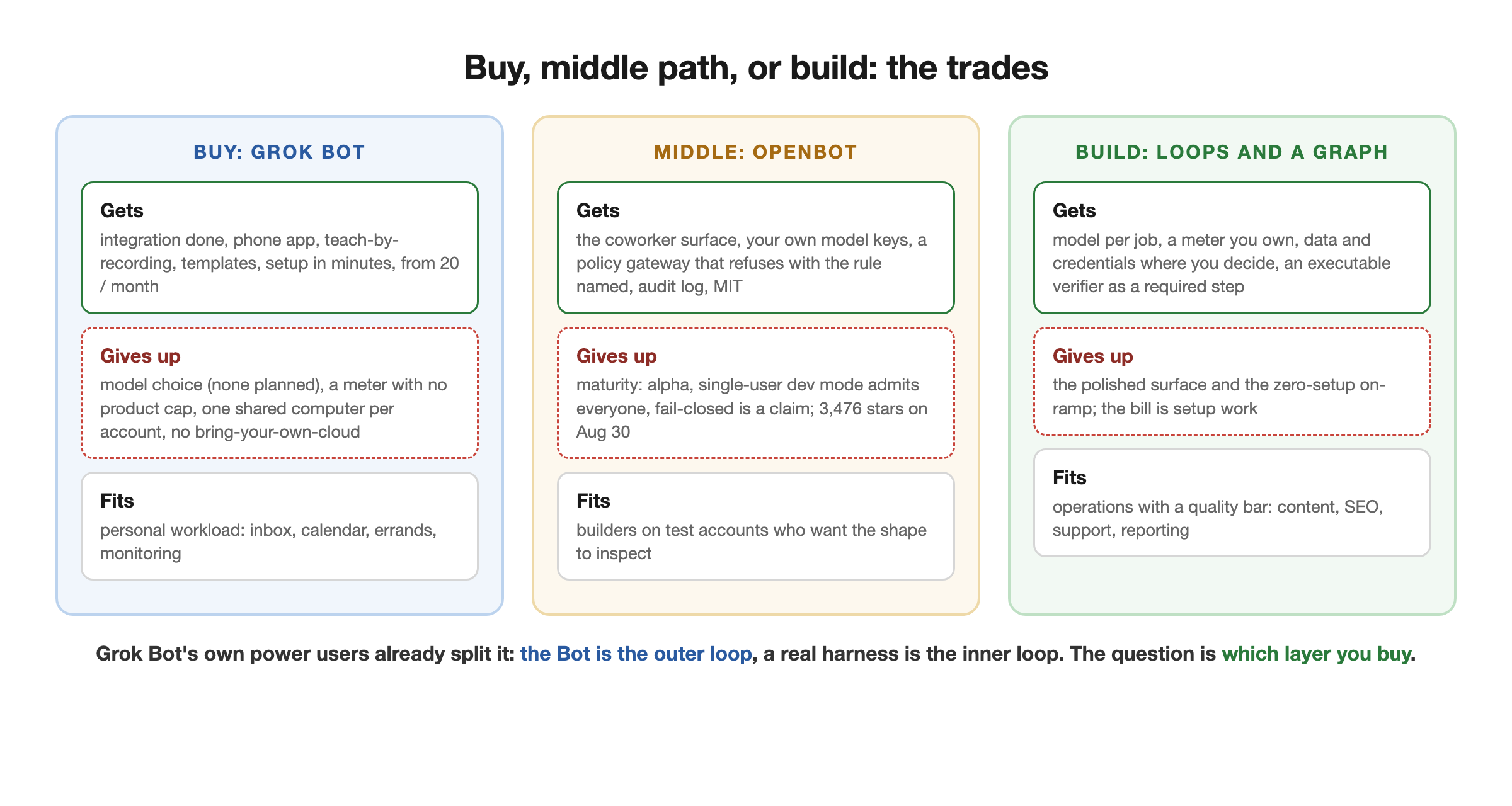
The framing comes from one of Grok Bot's own advocates, Alex Finn, after a week of daily use: there is nothing it can do that other agent stacks cannot; the user experience is what "unhobbles" the use cases. That is the premise of this comparison. You are not choosing capability. You are choosing who does the integration work, who controls the models and the meter, and where your data lives.
What the subscription buys
Grok Bot's launch post promises, and its first-fortnight tutorials confirm: Bots with a persistent cloud computer that sign into real tools (including sites with no API), an iMessage-style surface with zero workflow setup, scheduled Routines, automatic memory, agent-to-agent messaging with a chief-of-staff convention, and a screen-recording teach-a-task feature. Setup measured in minutes, on a Mac, a Windows PC, or an iPhone, and, since August 26, on plans from 20 dollars a month.
The costs, equally documented in our guide and pricing page: Grok-backed Bots with no model picker (the teams documentation: "Grok Bot has no model picker, for members or admins. We do not plan to allow admin or user choice"); a weekly usage allowance of unpublished size, then, if on-demand usage is enabled, on-demand billing with "no Grok Bot-specific spend cap yet"; no Android; one computer per account shared by every Bot, so separate Bots are not a security boundary; and your mail, calendar, files, and logins living on a hosted computer you do not control, with no bring-your-own-cloud option. That last point is the deal-breaker for at least one enterprise founder, who wrote that without an offering he can run on his own cloud he is "not touching it with a barge pole for work use-cases." And the most measured paying-user review we found after a week landed on the same axis: worth it "if you value the virtual machine it runs on and all the Cursor usage. It's not worth it just based on Grok Bot itself," with vendor control of models and rate limits as the reason to keep an open harness beside it.
What building buys
The build path is the one this site documents end to end: agent loops for recurring jobs, graphs when loops need coordination, run on whatever harness and models fit each job. Its trades are the mirror image:
- Model choice, per job. Cheap models for bulk work, frontier models for judgment, local models for private data. Notably, Alex Finn, one of Grok Bot's most visible advocates, keeps a second open harness alongside it for exactly this reason.
- The meter is yours. Token spend is a design surface (schedules, caching, scoped triggers) rather than a plan limit that ends your week on a Tuesday.
- You choose and audit where data and credentials live. A custom build can still call hosted model APIs, and OpenBot's default quick start uses CopilotKit's hosted Intelligence service for threads and memory (self-hostable if you take that on); the difference is that every one of those flows is your explicit choice to make and inspect.
- Verification as a required step. A built loop can make an executable verifier a mandatory transition before anything ships. The Grok Bot materials we reviewed do not document an equivalent configurable output gate; without a configured gate, review remains manual. For operations, we judge this the decisive difference.
- Grok Bot's own power users already split the work this way. The staff and paying users who wrote up their setups treat Grok Bot as the outer loop (context gathering, spec writing, delegation) and keep a real coding harness as the inner loop: "I'm not replacing the coding harness, I'm calling the coding harness," in a Cursor staffer's words, and "Grok Bot is definitely not the best choice for writing your production code" in a paying user's. Buy-versus-build is, in practice, a question of which layer you buy.
- The bill for all of it is setup work, and the real skill is writing your bars down: the verifier discipline is most of what separates a built agent team that compounds from a pile of cron jobs.
Free AI Builder Newsletter
Weekly guides on AI tools & builder strategies.
The middle path: OpenBot
Within days of Grok Bot's launch, CopilotKit built OpenBot (repository created August 17, publicly announced August 19): MIT-licensed, self-hosted, bring-your-own model keys, and harness-agnostic, meaning any agent speaking the AG-UI protocol can be a coworker-bot: LangGraph, Mastra, CrewAI, Pydantic AI, Google ADK, or hand-written. It reproduces the governance shape a company actually needs (a gateway that audits every action against written policy and refuses with the rule named, encrypted credentials, an audit log, human takeover at login walls) and it stood at 2,739 GitHub stars when we checked on August 25, and 3,476 on August 30.
It is also explicitly alpha, and its own materials are honest about the sharp edges: the default single-user dev mode admits every request as an admin, fine on a laptop and not fine on a network, and fail-closed policy enforcement is the claim rather than a proven guarantee. The walkthroughs' advice matches ours: run it on test accounts, not your real work identity, and watch the repo mature. For builders, it matters because it converts the AI-employee shape from a subscription into an architecture you can inspect.
Which Path Fits Which Job
Our recommendation, stated as judgment:
- Personal workload (inbox, calendar, errands, monitoring), no infrastructure appetite: buy. That is the job Grok Bot is designed for and the one its tutorials and user reports describe it handling, and packaging is worth paying for. Go in with the limit-burn tactics from day one.
- Business operations (content pipelines, SEO, support, reporting) where output needs a quality bar: build. Operations want executable verification, cost control, and model choice, and they are exactly what loops are for. This is the lane where we have receipts of our own.
- You want the coworker UX and you are a builder: watch OpenBot, contribute if inclined, and prototype on test accounts while its policy enforcement hardens. Plugging harness-built agents into a governed coworker surface is plausibly where both paths converge.
- Both. A subscription Bot for the personal layer, built loops for the operations layer, and a firm rule about which credentials each side is allowed to hold.
If the sort points you at build, the path is not mysterious: one recurring job, one loop, one verifier that is not you. The Loop Engineering course takes it from zero to a loop that wakes on schedule and ships behind quality gates, which is the unit every AI-employee architecture, bought or built, is made of.
Related Content
- Grok Bot: How to Use It - The full guide: setup, the chief-of-staff pattern, use cases with receipts, and the usage-limit problem.
- Grok Bot vs Claude Tag - The other buy-side comparison: two message-an-AI-teammate products with very different architectures.
- Grok Bot Pricing and Usage Limits - The meter, tier by tier.
- Loop Engineering: Stop Writing Prompts, Start Writing Verifiers - The build path's core discipline.
- How to Become an AI-Native Company - Sequencing which operations to hand to agents first, whoever runs them.
- Who Owns Your AI Agents - Credentials, autonomy ladders, and the registry: the governance layer both paths need.
Frequently Asked Questions
Is there an open-source alternative to Grok Bot?
Yes: OpenBot, from CopilotKit, MIT-licensed; the repository was created August 17, 2026 and publicly announced August 19, roughly a week after Grok Bot. It reproduces the shape (persistent coworker-style bots, a policy gateway, credentials, audit log, human takeover for login walls) but self-hosted, with your own model keys, and harness-agnostic: any agent that speaks the AG-UI protocol can be a bot, including LangGraph, Mastra, CrewAI, Pydantic AI, and Google ADK agents. It is explicitly alpha: its own docs default to a single-user dev mode that is unsafe on a network, and its policy enforcement is not yet a proven guarantee, so do not point it at real work accounts yet.
When is buying Grok Bot the right call over building?
When the jobs you want covered are personal-workload shaped (inbox, calendar, errands, monitoring), when nobody on the team wants to own agent infrastructure, and when the value of zero setup outweighs model lock-in and metered usage. The product's real edge in its first fortnight is packaging and persistence, not capability, and for a lot of people packaging is exactly what they are paying for.
When does building your own AI employee win?
When the jobs are operations rather than personal workload, when you need model choice (including cheap or local models), when usage economics matter (Grok Bot's fastest-documented complaint is limit burn), when you need to choose and audit where data, credentials, and model calls go, or when the agent's work product needs verification gates rather than a chat thread. Building costs setup time and demands you write your own quality bars; that work is the product.
Sources & Verification
Grok Bot facts are from SpaceXAI's launch materials and the transcribed tutorials documented in our Grok Bot guide (all reviewed 2026-08-25). OpenBot facts are from the CopilotKit/OpenBot repository README (stars and status read via the GitHub API on 2026-08-25 and again on 2026-08-30; the Grok Bot plan, platform, and model-picker facts were re-checked against docs.x.ai and the August 26 expansion post on 2026-08-30), Atai Barkai's announcement post, and the transcript of Julian Goldie's walkthrough video, including its security caveats. The build-side characterization describes the practice this blog documents from production use. The decision sort is our judgment and labeled as such. See our editorial standards.
- Introducing Grok Bot (SpaceXAI) - What the subscription buys: Bots with their own computer, tool sign-ins, 24/7 work, approvals-only interruptions
- CopilotKit/OpenBot (GitHub) - The open-source Grok Bot analog: MIT, alpha, 2,739 stars when read on 2026-08-25 (repository created 2026-08-17); AG-UI protocol, self-hosted, bring your own harness and model; 3,476 stars on 2026-08-30 via the same API
- OpenBot announcement (Atai Barkai, CopilotKit) - An open source Grok Bot that works with ANY agent harness, designed for real companies; 748k views. Barkai is CopilotKit's CEO
- NEW Open Bot Is an Open-Source Grok Bot! (Julian Goldie) - The walkthrough this page's OpenBot security caveats come from: alpha 0.0.1, the single-user dev-mode default, unresolved authorization concerns, and fail-closed as a claim rather than a guarantee
- Grok Bot for teams and enterprises (docs.x.ai) - 'Grok Bot has no model picker, for members or admins. We do not plan to allow admin or user choice'; 'There is no Grok Bot-specific spend cap yet'; one computer per member shared by all Bots
- 6 lessons learnt closing a 10M-plus AI deal at a F500 (Tanmai Gopal, 2026-08-24) - The enterprise objection: without a run-it-on-my-own-cloud offering, 'not touching it with a barge pole for work use-cases'
- Is it worth it? Grok Bot edition (Aaron, 2026-08-21) - Paying user after a week: worth it for the VM and Cursor usage, not on Grok Bot alone; vendor control of models and limits
- Alex Finn's week-of-usage verdict - The line this page's framing leans on, from a Grok Bot advocate: nothing it can do that the others cannot; the user experience unhobbles the use cases
- Grok Bot: How to Use It (AI Builder Club) - Our full guide, including the verified usage-limit problem and the use cases with receipts
Join AI Builder Club


$37/mo
Get the free newsletter
Weekly deep-dives on AI tools, automation workflows, and builder strategies. Join 5,000+ readers.
No spam. Unsubscribe anytime.