Grok Bot vs Claude Tag: The Real Differences
Both let you message an AI teammate. One lives in its own app with its own computer; one lives in Slack on your org's balance. Which fits which team.
Seven weeks apart, the message-an-AI-teammate category got its two defining products: on June 23, 2026, Claude Tag put a persistent Claude inside Slack channels, and on August 11 Grok Bot shipped named agents with their own computer in an iMessage-style app of their own. People keep comparing them because the pitch sounds identical: stop prompting, start delegating to something that remembers you. The architectures underneath are almost opposite, and the differences decide which one fits.
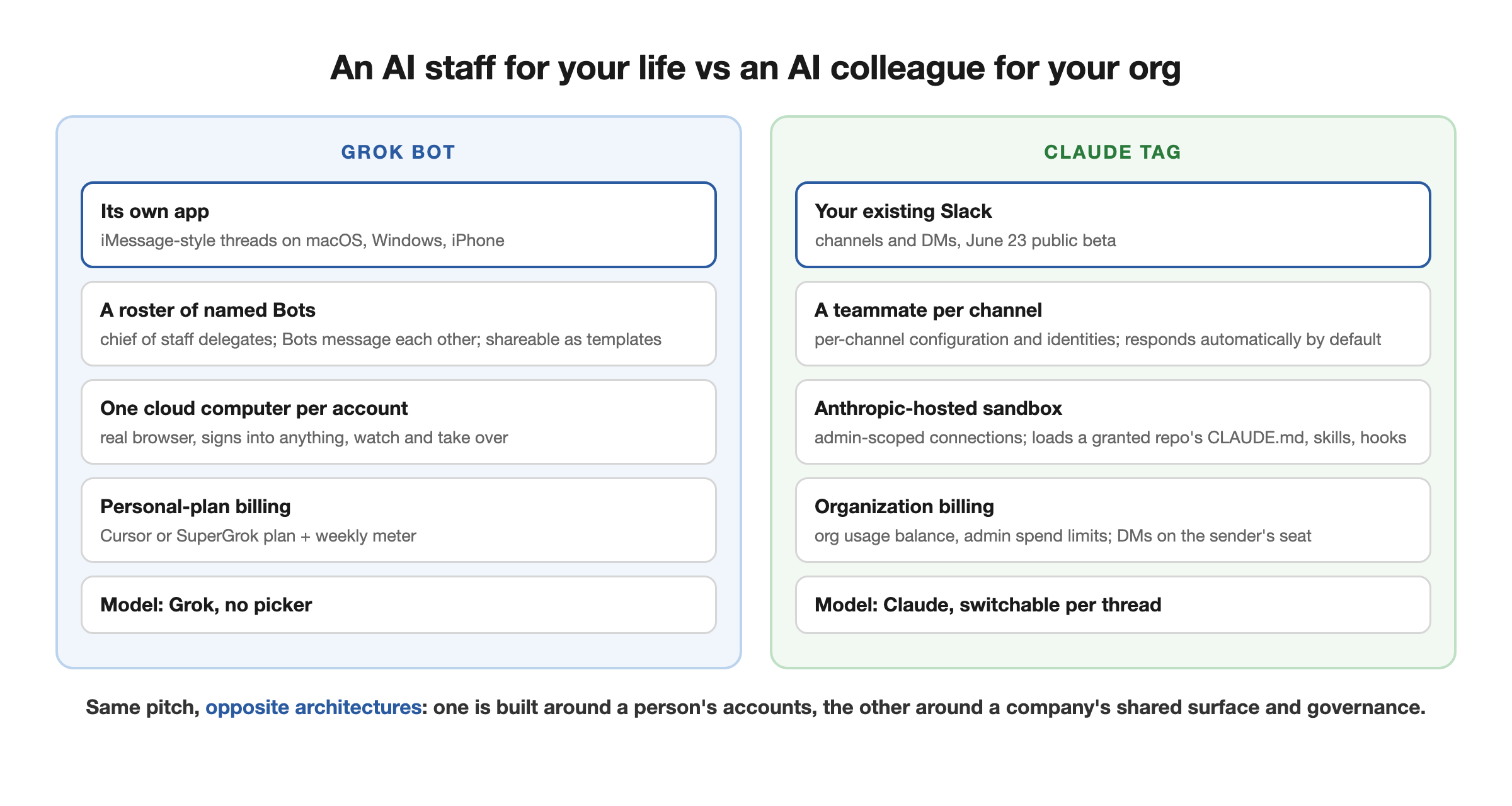
The Differences, Side by Side
| Grok Bot (SpaceXAI) | Claude Tag (Anthropic) | |
|---|---|---|
| Lives in | Its own app, macOS, Windows, and iOS, iMessage-style threads | Your existing Slack workspace, channels and DMs |
| The agent's computer | One persistent cloud computer per account, shared by all your Bots, with a real browser you can watch and take over | Anthropic-hosted sandbox; no persistent personal VM |
| Reaches tools by | Signing in like a person, including sites with no API, plus a Plugins surface | Organization-managed connections an admin scopes per channel |
| Org model | You build a team of named Bots; chief-of-staff delegation; Bots message each other | Claude as a teammate per channel, with per-channel configuration and identities |
| Configuration | Bot descriptions (the system prompt), Routines, teach-a-task screen recordings, and shareable templates since August 28 | CLAUDE.md, skills, and hooks loaded from GitHub once a granted repo is named and cloned, plus admin settings |
| Models | Grok-backed; no model picker, and the teams docs say none is planned | Claude, same engine as Claude Code; admin-set channel default with per-thread switching |
| Who it is for today | Since August 26, every individual SuperGrok plan and every paid Cursor plan, from 20 dollars a month; enterprise waitlisted | Teams on Claude Team or seat-based Enterprise, Routines enabled |
| Billing shape | Subscription plans (SuperGrok or Cursor) with metered usage limits (the product's most documented pain point) | Organization usage balance for channel work, sender's own seat for DMs, admin spend limits |
| Scheduled and proactive work | Routines on schedules and event triggers | Routines and scheduled work, admin-gated |
| Replies to untagged messages | Not the model; you message Bots directly | Respond automatically, on by default per channel |
| Beta since | 2026-08-11 | 2026-06-23, public beta |
Our one-line summary, stated as judgment: Grok Bot is an AI staff for your life; Claude Tag is an AI colleague for your org. One is built around a person's accounts, errands, and inbox, reached through an app of its own. The other is built around a company's shared surface, governance, and repos, reached through the chat tool the company already lives in.
Free AI Builder Newsletter
Weekly guides on AI tools & builder strategies.
What Each Product Does Best
Grok Bot's edge is the computer. A persistent browser that holds logins does jobs the interface of a channel assistant is not built around: shopping returns, bookings, working inside tools that have no API. Its multi-Bot pattern (a pinned chief of staff delegating to specialists that message each other) is the most fully productized agent-team pattern we have reviewed, and since August 28 a tuned roster can be shared as a template that someone else installs in one click. Our guide covers the pattern and the usage-limit problem that comes with it; the pricing page covers the meter.
Claude Tag's edge is the org. Channel work bills to an organization balance under admin spend limits rather than a personal quota; access, tools, and data scopes are governed per channel; and, for teams whose work lives in repos, once a channel session clones a granted repo it loads that repo's CLAUDE.md, skills, and hooks, so the standards you wrote for Claude Code follow it into Slack. Our Claude Tag guide has the doc-verified setup and billing detail.
Neither replaces a real harness. Claude Tag shares no context with your local Claude Code; Grok Bot's reviewed materials document no model picker, and Alex Finn keeps an open harness next to it. For work that is an operation with a quality bar rather than a stream of requests, our recommendation is a built loop with an executable verifier, whichever teammate product you also run; that decision in full is Grok Bot vs building your own.
Our Recommendation
Choose by where the work already lives. Personal workload and errands, no Slack culture: Grok Bot, with the limit-burn tactics from day one. A Slack-native team wanting governed shared access: Claude Tag. A builder who wants the teammate shape with model choice and auditable data flows: neither, yet; that is the build path, and its unit is the loop.
Related Content
- Grok Bot: How to Use It - Setup, the chief-of-staff pattern, receipts-ranked use cases, and the usage-limit problem.
- Claude Tag: What It Is and How to Use It in Slack - The doc-verified guide: pairing, billing, Respond automatically, and the Claude Code relationship.
- Grok Bot vs Building Your Own AI Employee - The third option both comparisons point at, with the open-source middle path.
- How to Become an AI-Native Company - What delegation looks like when it graduates from a teammate to an operation.
Frequently Asked Questions
What is the main difference between Grok Bot and Claude Tag?
Where the teammate lives and what it can touch. Grok Bot is its own iMessage-style app: named Bots with a persistent cloud computer and browser that sign into arbitrary tools and websites like a person, aimed first at individuals. Claude Tag lives inside your existing Slack workspace: Claude joins channels, works in threads on Anthropic-hosted infrastructure with organization-managed connections, and is aimed at teams on Claude Team or Enterprise plans.
Which is better for a team?
As of their current betas, Claude Tag fits teams that already run on Slack and want shared, admin-governed access with organization-level billing and spend limits. Grok Bot's multi-Bot pattern is powerful but oriented around one person's accounts and workload, and access is gated through SuperGrok or Cursor subscriptions (including Cursor Teams), with enterprise waitlisted. Teams whose work is repo-shaped also get a specific benefit from Claude Tag: once a granted repo is named and cloned it loads that repo's CLAUDE.md, skills, and hooks, so channel sessions inherit your standards.
Do Grok Bot and Claude Tag replace Claude Code or other coding harnesses?
No on both counts. Claude Tag runs the same engine as Claude Code but hosted, with no access to your local machine, settings, or MCP servers, and no context shared between the two. Grok Bot's reviewed materials document no model picker, and its most visible advocate keeps a separate harness for model choice and heavy engineering work. Both are delegation surfaces, not replacements for the harness you build in.
Sources & Verification
Claude Tag facts were verified against Anthropic's live documentation on 2026-08-24 (setup, billing, the Respond automatically setting, and the Claude Code relationship; the doc URLs are on our Claude Tag page's source list). Grok Bot facts are from SpaceXAI's launch materials and the transcribed tutorials documented in our Grok Bot guide, reviewed 2026-08-25, and re-checked on 2026-08-30 against the Grok Bot FAQ and teams documentation, the August 26 plan expansion, and the August 28 template-sharing documentation, all listed below. Both products are in beta and moving; treat specifics as of these dates. The recommendations are our judgment. See our editorial standards.
- Introducing Grok Bot (SpaceXAI) - Grok Bot's launch post: own computer, tool sign-ins, 24/7, approvals-only interruptions
- Grok Bot is now included with more plans (SpaceXAI, 2026-08-26) - Every SuperGrok plan and every paid Cursor plan now include Grok Bot
- Grok Bot FAQ (docs.x.ai) - One computer per user shared by all Bots; platforms macOS, Windows, iPhone
- Grok Bot for teams and enterprises (docs.x.ai) - 'Grok Bot has no model picker, for members or admins. We do not plan to allow admin or user choice'
- Create and manage Bots: Share a Bot (docs.x.ai) - Template sharing: public link, preview on x.ai, a copy on the recipient's account
- Claude Tag setup overview (Anthropic docs) - Claude Tag's pairing flow, Team/Enterprise requirement, Routines prerequisite, and organization usage-balance billing
- Claude Tag for Claude Code users (Anthropic docs) - Same engine as Claude Code, hosted in Anthropic's sandbox; reads repo configuration from GitHub, not your machine
- Claude Tag: What It Is and How to Use It in Slack (AI Builder Club) - Our full Claude Tag guide, with the doc-verified setup, billing, and Respond automatically details
- Grok Bot: How to Use It (AI Builder Club) - Our full Grok Bot guide, with the chief-of-staff pattern, receipts-ranked use cases, and the usage-limit problem
Join AI Builder Club


$37/mo
Get the free newsletter
Weekly deep-dives on AI tools, automation workflows, and builder strategies. Join 5,000+ readers.
No spam. Unsubscribe anytime.