Graph Engineering Guide (2026)
Graph engineering: the 2026 shift from a single agent loop to a multi-node agent graph. What it is, loops vs graphs, Google ADK, real skill or rebrand?
Join AI Builder Club for courses, community, and weekly workshops.
30-day money-back guarantee. $37/mo.
Course outline · Build AI Agents (4.17)
Graph engineering is the practice of wiring multiple specialized agents or steps into a graph - nodes that do the work, edges that route between them, and shared state flowing along those edges - for when a single agent running one loop isn't enough. It's the framing that lit up X in mid-July 2026 as the layer above loop engineering. And the very first thing an honest guide has to tell you is this: most tasks never need it, and the people mocking it as slop have a point you should keep in your pocket the whole way through.
Here's the moment it clicked for a lot of people. You've got an agent happily grinding through a loop - discover, plan, execute, verify, repeat - and it's fine, until the task stops being one job. Now it's research this, then write it up, then have something skeptical tear the draft apart, then decide whether to ship or send it back. You can cram all of that into one agent's loop and watch it lose the plot. Or you can give each of those jobs its own node and wire them together. The second thing is a graph.
This guide is the plain, non-hype decode: what a graph actually is, when it genuinely beats a loop (and when it's just complexity you'll regret), the frameworks that quietly did this a year before the buzzword, and a clear-eyed answer to the loudest question on the timeline - is this just slop?
What Is Graph Engineering?
Graph engineering is the practice of designing the graph your agents run in: which specialized nodes exist, which edges route work between them, and what shared state travels along those edges. Loop engineering designs the cycle one agent repeats. Graph engineering decides how several of those loops connect. A single loop is the smallest possible graph - one node with an edge back to itself - so this isn't a replacement for loop engineering. It's the layer directly above it.
The sharpest one-line test showed up on X on July 20, 2026. @shannholmberg framed loops and graphs as two ways to run an agent where "the difference is who decides the path, the agent or you." In a loop, you set the goal and the bar, and the agent picks its own route to clear it. In a graph, you declare the valid paths and the checks along them - this node, then that one, branch here if the review fails - while some edges still get decided at runtime, so the agent's freedom lives inside each node instead of across the whole job.
That framing also explains why the term drew fire as fast as it drew followers. Harrison Chase, who built LangGraph, replied to that same thread: "So i didn't really know what graph engineering is, and i still don't really... but it's basically just langgraph?" When the person whose framework is the reference implementation isn't sure the word names anything new, that's worth registering rather than waving off - we take the question seriously in Is Graph Engineering Just LangGraph?. Pushing the other way, @daleverett published a piece on July 19 titled "Loops are just shitty graphs", arguing the graph was always the real structure and the single loop was the degenerate case we settled for.
Three things graph engineering is not, because all three get confused with it:
- Not knowledge graphs or GraphRAG. Those are about modeling data as entities and relations for retrieval. Graph engineering is about modeling execution - which agent runs next and what state it gets. Same word, unrelated problem.
- Not a new capability. Nothing shipped in July 2026 that you couldn't build in 2025. LangGraph, Microsoft AutoGen, and Google ADK were doing graph orchestration well before the term existed. What's new is the vocabulary.
- Not a default. Most tasks are one job with one verifier, and that's a loop. Reaching for a graph before the work forces you is how you buy yourself a distributed-systems problem you didn't have.
If you want the mechanics - what a node, an edge, and shared state actually are in practice - that's the next section.
How Did We Get From Loops to Graphs?
Every year the leverage in AI engineering moves one level further out from the model. It helps to see the whole line at once:
| Era | Layer | What you engineer | Your role |
|---|---|---|---|
| 2023-24 | Prompt | The request you send | Operator |
| 2024 | Context | What the model gets to see | Editor |
| 2025 | Harness | The tools, memory, and scaffolding around it | Toolmaker |
| Early 2026 | Loop | The cycle one agent repeats until done | System designer |
| Mid 2026 | Graph | The coordination between many agents/steps | Org designer |
We covered the first four rungs in Loop Engineering: Stop Writing Prompts, Start Writing Verifiers and traced the whole climb in From Prompts to Loops: The 4 Shifts. Graph is the newest rung, and it's newest by a matter of days.
The word crystallized on X around July 18-19, 2026. The seed was a question. Peter Steinberger - the creator of OpenClaw - asked, in a line relayed by @sairahul1: "Are we still talking loops or did we shift to graphs yet?" That's the whole origin: not a launch, not a paper, a builder wondering out loud whether the frame had already moved.
Within a day the timeline answered. @svpino put it as a mock-eulogy: "Loop Engineering is dead. Long live Graph Engineering!" @rohit4verse gave it the framing that stuck: "Loop engineering was the last unlock. Graph engineering is the next one. Agents are graduating from while-loops to org charts. Specialized nodes running in parallel, state flowing between them." And @VaibhavSisinty described the underlying motion without the hashtag: "There's a quiet shift happening in how AI agents are built... For the last year, AI agents worked in loops. You give it a task. It plans. It acts. It checks. It fixes."
Notice what's not here: a new capability. Nobody shipped a thing on July 18 that you couldn't do on July 17. What shifted was the name people put on a design problem they were already having - the problem of one loop no longer being the right shape for the work. Hold onto that. It's the crux of every honest take below.
What Is an Agent Graph, Exactly?
Strip the jargon and an agent graph has exactly three parts:
- Nodes - the units that do work. A node is usually a specialized agent (a "researcher," a "writer," a "reviewer") or a plain deterministic step (a function, a tool call, a data fetch). Each node has one job.
- Edges - the routing between nodes. An edge says after this node, go to that one. Edges can be straight (A then B), conditional (if the review passes, ship; if not, loop back), fan-out (one node kicks off three in parallel), and fan-in (three results join back into one).
- Shared state - the object that travels along the edges. It's the thing every node reads from and writes to: the task, the draft so far, the notes, the verdict. State is what turns a pile of agents into a system instead of a group chat that forgets everything.
The metaphor that's doing the heavy lifting on X is @rohit4verse's org chart. A company doesn't make one person do research, writing, and review in a single unbroken stint. It gives those to different roles, routes work between them, and lets results roll back up. An agent graph is the same idea: specialized roles, defined hand-offs, a shared record.
Worth being honest about how far that metaphor travels: when the roles are actual business functions rather than nodes in one workflow, most teams never need edges at all. Point every loop at the same folder and let it read state, work, and write state back. That version, and the order to convert functions in, is in how to become an AI-native company.
Here's the canonical starter graph - a researcher feeds a writer, a reviewer checks the draft, and a conditional edge decides whether to ship or send it back:
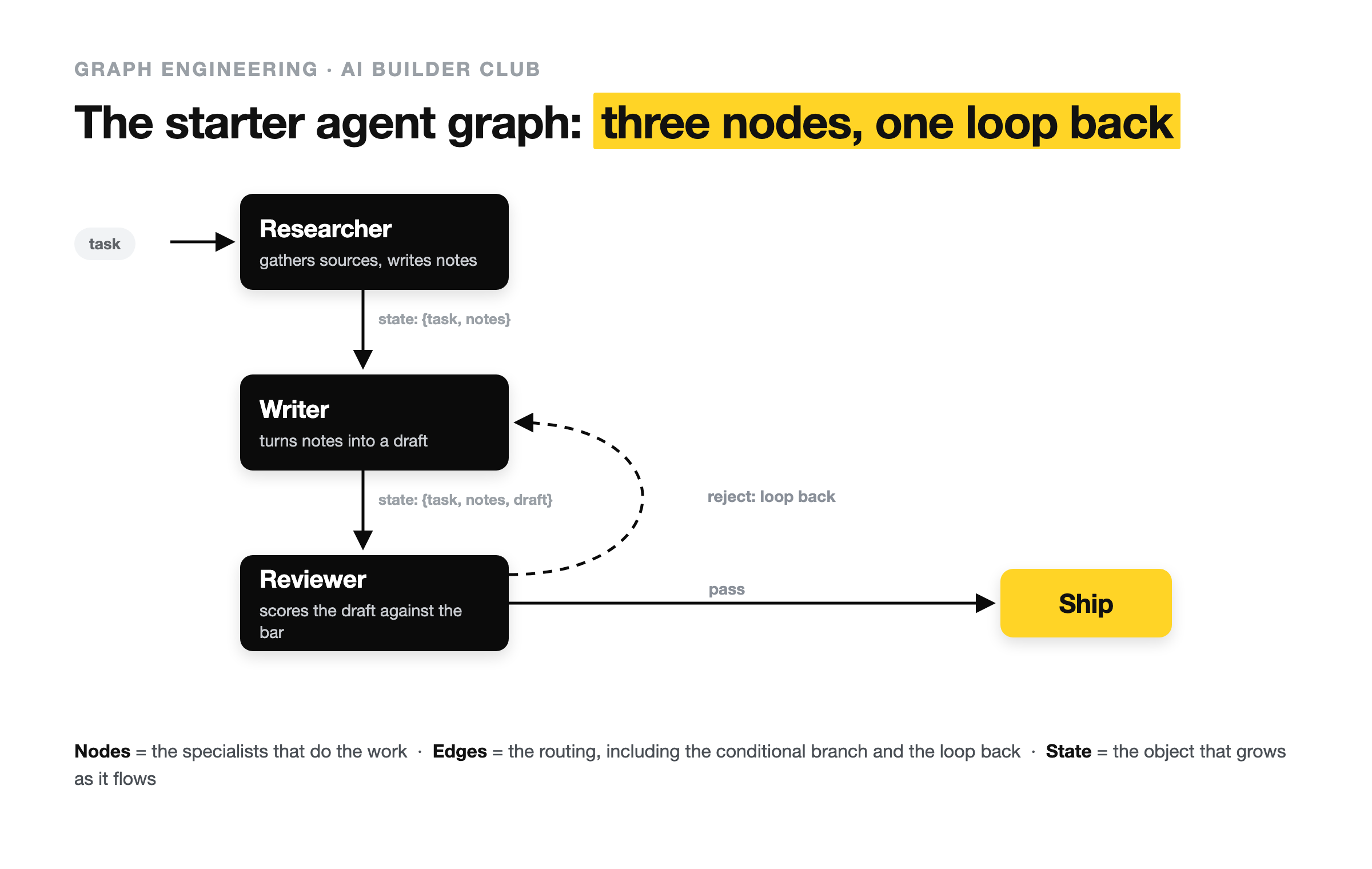
Three nodes, four edges - one of them conditional, one of them a loop back to the writer. State grows as it flows: the researcher's notes ride along to the writer, the draft rides along to the reviewer, and the reviewer's verdict decides the next edge.
Now the part that keeps the whole thing from feeling like a brand-new universe: a loop is just a single-node graph with an edge back to itself. Everything you learned about designing loops - the discover/plan/execute/verify cycle, the stop condition, the verifier - is the inside of one node. A graph doesn't replace the loop. It's what you get when you have several loops that need to hand off to each other. If you want the taxonomy of what those individual loops can look like, we mapped it in The Types of Agentic Loops. Graph engineering is the layer that decides how they connect.
When Should You Reach for a Graph?
This is the question that separates the useful builders from the people adding boxes to a diagram for fun. The default answer - and we mean this as the load-bearing claim of the whole guide - is: you probably don't. A single well-scoped task with a clear verifier is a loop, and reaching for a graph there is pure overhead.
Here's the honest decision table:
| Signal in the work | Loop is enough | Reach for a graph |
|---|---|---|
| Shape of the task | One job with a clear finish line | Splits into distinct specialties that hand off |
| Parallelism | Steps are sequential | You need fan-out (many at once) then a join |
| Tools / models per step | Same tools throughout | Different model or toolset per step |
| Control flow | One agent can free-roam safely | You need explicit, auditable routing between roles |
| Failure isolation | A bad step just retries | You want one bad node to fail without poisoning the rest |
| Who verifies | The agent checks its own loop output | A dedicated reviewer node checks another node's work |
Read that table as a set of triggers, not a checklist to satisfy. You don't need all six. But if the honest answer to most of them is the left column, building a graph is how you turn a two-hour task into a two-day framework project.
OVER-ENGINEERED - GRAPH YOU DIDN'T NEED
"Summarize this PDF." You build a five-node graph: a fetcher, a chunker, a summarizer, a reviewer, and a formatter, with conditional edges and a shared state object. It works - and it's slower to build, harder to debug, and more expensive to run than the one thing it should have been: an agent in a loop that reads the file and writes a summary. You engineered an org chart to answer an email.
RIGHT-SIZED - GRAPH THAT EARNS ITS KEEP
"Produce a researched, fact-checked market brief every morning." A researcher node fans out across five sources in parallel; a synthesizer joins their findings; a writer drafts; a skeptical reviewer node - different model, read-only - scores it and loops back on a fail. Each node has a job a single loop couldn't hold, and the hand-offs are the point.
The tell is whether the graph is doing work the loop couldn't. If you can collapse your five nodes back into one agent's loop and lose nothing, you should. We go deeper on the exact call - the borderline cases, the cost math, and the migration path - in Agent Graph vs Loop: When to Use Which, and on how the two disciplines relate as disciplines in Graph Engineering vs Loop Engineering. The one-line version: master the loop first, and only split it into a graph when the work forces your hand.
Building your first node before you wire a graph? That single scheduled, self-verifying agent is exactly what the Loop Engineering course builds, step by step, with the weekly live workshops to unblock you when yours misbehaves.
Free AI Builder Newsletter
Weekly guides on AI tools & builder strategies.
Isn't This Just LangGraph?
The sharpest reply on the timeline was some version of "congrats, you reinvented LangGraph." It deserves a straight answer, because it's mostly right and pretending otherwise is exactly the hype the skeptics are calling out.
The idea of building agent systems as graphs of nodes and edges over shared state shipped in real tools well before the term "graph engineering" trended. Here's the honest prior art, described only at the level the official docs support (as of July 2026):
- LangGraph (from LangChain) is, per its own docs, "a low-level orchestration framework and runtime for building, managing, and deploying long-running, stateful agents." In practice you define a
StateGraph, add nodes, and add the edges between them - the exact nodes/edges/state model above. If you've used LangGraph, you've been doing graph engineering under a different name. (docs) - Microsoft AutoGen - GraphFlow brought graph-based multi-agent orchestration to AutoGen: you describe how a team of agents connects and hands off, rather than running one agent in isolation. Know before adopting: AutoGen is officially in maintenance mode (no new features, community managed), and Microsoft points new users at its successor, Microsoft Agent Framework, which carries the multi-agent orchestration forward with A2A and MCP support. AutoGen still matters here as prior art; it is no longer the thing to build on.
- Google ADK (Agent Development Kit) makes the graph model a headline feature. Its docs describe orchestrating "complex tasks through structured, graph-based architectures," and ship named sequential, parallel, and loop workflow agents, plus agent routing - fan-out/fan-in and loops as first-class building blocks. (Its Go SDK hit a 2.0 GA in 2026; the graph model spans the Python/TypeScript/Java/Kotlin SDKs too.) (docs) Google's own loop-to-graph move, and the "free Google graph engineering course" claim going around, get the full treatment in Google Graph Engineering.
- A2A (Agent2Agent) is an open protocol for agents to delegate to each other across systems - the "edges between graphs owned by different teams" layer. It's worth naming because it's the clearest evidence the multi-agent idea has real, pre-buzzword history in the enterprise (more on that from a skeptic below).
So: is graph engineering just LangGraph? The technology, largely yes - LangGraph, GraphFlow, and ADK got there first. What's actually new in mid-2026 is narrower and softer: a shared name for the design decisions those frameworks always asked of you (what are the nodes, what are the edges, what's in the state), and a growing sense that this is a distinct skill worth teaching rather than a framework detail. That's a real thing. It's just a much smaller thing than "a new paradigm," and we say so plainly in Is Graph Engineering Just LangGraph?.
What Are the 5 Layers of AI Engineering?
The cleanest way to place graph engineering without overselling it comes from @sairahul1, who framed the whole stack in one line: "Prompt, context, harness, loop & graph engineering, clearly explained! The best AI engineers don't just write prompts anymore. They engineer the entire system around the model. You can think of an AI application as five layers."
Each layer engineers the system one step further out from the model:
| # | Layer | What it engineers | The core question |
|---|---|---|---|
| 1 | Prompt | The single request | Am I asking well? |
| 2 | Context | What the model sees | Does it have the right information? |
| 3 | Harness | Tools, memory, scaffolding | Can it act on the world and remember? |
| 4 | Loop | The repeat cycle one agent runs | When does it check its work and stop? |
| 5 | Graph | Coordination between many agents/steps | Who does what, in what order, sharing what state? |
The useful thing about the stack is that it's cumulative, not a ladder you climb away from. A graph is full of nodes; a good node is a well-designed loop; a good loop needs a real harness - the six components (context, tools, orchestration, state, evaluation, recovery) that make an agent able to act at all. Skip a lower layer and the graph on top just fails in a more elaborate way. If your nodes are weak agents, wiring them into an org chart gives you a weak org. We break the full stack down layer by layer in The 5 Layers of AI Engineering; the short version is that graph engineering is the outermost layer, which also makes it the one you should reach for last.
Is Graph Engineering Just Slop?
Time for the section the skeptics will scroll straight to - and they've earned it, because the backlash arrived almost before the term did. This is the same move we made in the loop guide: separate the word from the shift, concede everything that's fair, and land somewhere you can actually defend.
The critics aren't cranks. They're some of the people who know this domain best:
- @RhysSullivan called the shot before the article existed: "there's going to be a 10,000 word slop article on x tomorrow about graph engineering," and then, dryly, when one appeared: "a graph engineering article has hit the timeline." The mockery is aimed at the content-farm gold-rush around the term, and it's fair - a lot of what got published that week was exactly that.
- @DavidKPiano, the creator of XState - a person who has spent years building state-machine tooling - warned: "Keep this in mind before reading a slop article about 'agent graph engineering'." When a literal state-machine expert rolls his eyes at "graphs" being announced as new, that's not gatekeeping; it's someone pointing out that directed graphs of states and transitions are decades-old computer science.
- @PawelHuryn went after the whole lineage: "I call BS on graph engineering. Loop engineering was already confusing..." His alternative, in his own framing, is to skip the mechanism-naming and just give the agent the objective, why it matters, and how success gets measured. The point: the naming keeps mistaking the mechanism (loops, graphs) for the substance (objectives and verification).
- @NathanFlurry made the prior-art point concrete: "funny that these 'graph engineering' posts don't mention a2a." In a follow-up: "linkedin was on this in 2025, ibm is moving faster." His argument is that the multi-agent-delegation idea (A2A and its cousins) already has real enterprise history, so coining a Twitter term for it in July 2026 is late, not early.
Concede all of it, because all of it is true. The mechanics are not new: directed graphs, state machines, orchestration engines, and agent-to-agent protocols predate the buzzword by years. Much of the content riding the term is slop. And "graph engineering" as a phrase is optional - you can build every system in this guide and never once use the words.
Now separate the word from the shift. Under the noise, a real design escalation is happening, and it's the same one @VaibhavSisinty and @rohit4verse described: teams that spent early 2026 getting good at running one agent in a loop are hitting the wall where one loop is the wrong shape, and are deliberately splitting the work into coordinated, specialized nodes with state flowing between them. That escalation is real whether or not you call it "graph engineering," the same way loop engineering was real whether or not you liked the word. The skeptics aren't refuting the escalation - they're refuting the hype around a name for it, and on that they're correct.
So here's the filter, same as the loop guide:
- Are teams genuinely moving from "one agent in a loop" to "several specialized agents coordinated over shared state" when the work demands it? Yes.
- Is that coordination a distinct design skill - picking nodes, edges, and state - separate from designing a single loop? Yes.
- Is the word "graph engineering" new, load-bearing, or free of slop? No - the mechanics are old, and most of the July 2026 content is noise.
The label is optional. The escalation from one loop to a coordinated graph is real. Just don't reach for it before you need it - which, for most of what you're building this week, is not yet.
Your Graph Engineering Starting Checklist
Before you turn a loop into a graph, run the idea through this:
- Try to keep it a loop. Can a single well-scoped agent with a good verifier do this? If yes, stop here. You're done.
- Name the nodes only if they're real specialties. Each node should have a job a single loop genuinely couldn't hold - a different model, a different toolset, or a read-only reviewer role. "Steps I could inline" are not nodes.
- Draw the edges before you code. Sketch the routing: what's sequential, what fans out, what fans in, and where the one conditional/loop-back edge lives. If you can't draw it on a napkin, it's too complex.
- Design the shared state object explicitly. Decide what travels along the edges and who's allowed to write to it. State drift is the #1 way graphs rot.
- Give the reviewer node teeth. The single highest-value node is usually a separate, read-only verifier - a different agent from the one that produced the work. (This is the loop guide's "don't let an agent self-verify," promoted to a node.)
- Isolate failure. Make sure one node can fail and retry without corrupting the shared state or poisoning downstream nodes.
- Pick a framework instead of hand-rolling. LangGraph, Google ADK, or Microsoft Agent Framework (AutoGen's successor; AutoGen itself is in maintenance mode) already give you nodes, edges, state, fan-out/fan-in, and loops. Reinventing the runtime is its own kind of slop.
- Set a spend cap and a hard bound. A graph is many loops; a weak verifier now burns tokens in parallel. Cap it.
If you build a graph this week, the win condition isn't "it has the most nodes." It's "every node is doing work a loop couldn't, and I could still explain the whole thing in one breath."
Related Content
- I Don't Prompt Agents Anymore: Graph Engineering From the Inside - Jason's firsthand version: the three meanings of the term, code as graph vs LLM as graph, four node-design patterns, and two graphs running in production.
- Graph Engineering vs Loop Engineering - The boundary between the two disciplines, what each is for, and why the loop is the thing you master first.
- Agent Graph vs Loop: When to Use Which - The borderline cases, the cost math, and the honest migration path from one loop to a graph.
- Is Graph Engineering Just LangGraph? - The prior art in full: LangGraph, AutoGen GraphFlow, Google ADK, and A2A - and what's genuinely new versus a rebrand.
- Google Graph Engineering - What Google actually ships: ADK 2.0's graph-based and dynamic workflows, and why the "free Google graph engineering course" doing the rounds is not a Google course (the real free course behind the chatter is DeepLearning.AI's, built on ADK).
- The 5 Layers of AI Engineering - Prompt, context, harness, loop, graph - the whole stack, and why each layer only works if the one below it does.
- Loop Engineering: Stop Writing Prompts, Start Writing Verifiers - The layer directly beneath this one. A node is a loop; this is how to design it.
- Harness: The 6 Components - Context, tools, orchestration, state, evaluation, recovery. What makes a single node strong enough to wire into a graph.
- The Types of Agentic Loops - The taxonomy of loops that live inside your nodes.
Start Here
Graph engineering is the layer above loop engineering, and the fastest way to build a bad graph is to skip the loop. So the honest first move isn't "learn graphs." It's: nail the loop your first node will run - one agent, a clear verifier, an explicit stop condition - and only split it into a graph when the work forces your hand.
The Loop Engineering course is where to start: it takes you from "you are the for loop" to a single agent that wakes on schedule, pulls the top task off your backlog, ships behind quality gates, and reports back - the exact unit you'll later drop into a graph as one node. Nail the loop before you wire the graph.
For node/edge/state templates and teardowns of graphs that shipped (next to over-engineered ones that should have stayed a loop), join the AI Builder Club - come ship something real.
Jason ran this live in our August 2 workshop: the two ways to enforce a graph, and why he now defaults to writing them as a skill with the SOP inside it rather than as code. Watch the session.
Frequently Asked Questions
What is graph engineering?
Graph engineering is the practice of designing the graph your agents run in: which specialized nodes exist, which edges route work between them (including branches, fan-out/fan-in, and loops), and what shared state travels along those edges - instead of relying on a single agent running one loop. It's the framing that surfaced on X in mid-July 2026 as the layer above loop engineering. A single loop is the special case: one node with an edge back to itself.
Is graph engineering just hype?
Partly. Skeptics like @RhysSullivan, @DavidKPiano (creator of XState), @PawelHuryn, and @NathanFlurry are right that the mechanics aren't new - graph orchestration, state machines, and agent-to-agent protocols like A2A predate the term by a year or more. But separate the word from the shift: escalating from one loop to a coordinated set of specialized nodes with state flowing between them is a real design step teams take. The label is optional. The escalation is real - just don't reach for it before you need it.
What is an agent org chart?
It's @rohit4verse's metaphor for an agent graph: agents 'graduating from while-loops to org charts,' with 'specialized nodes running in parallel, state flowing between them.' Like a company org chart, each node has a job, work routes between roles, and results roll back up. It's a useful picture as long as you remember the caution: most work still gets done by one person in a loop, not a whole org.
Sources & Verification
This guide synthesizes the graph-engineering discussion that surfaced on X in mid-July 2026 (Peter Steinberger's question relayed by @sairahul1, plus @svpino, @rohit4verse, @VaibhavSisinty) and the documented capabilities of graph agent frameworks (LangGraph, Microsoft AutoGen, Google ADK). It explains an emerging term, not a firsthand benchmark - framework specifics re-verified 2026-08-24 against the official repos linked below. Framework descriptions are verified against the official docs linked below. See our editorial standards.
- microsoft/autogen README maintenance notice (GitHub) - AutoGen is in maintenance mode, community managed, no new features; new users directed to Microsoft Agent Framework (verified 2026-08-24)
- Microsoft Agent Framework (GitHub) - AutoGen's named successor: multi-agent orchestration with A2A and MCP support
- Loop Engineering: Stop Writing Prompts, Start Writing Verifiers (AI Builder Club) - The prior layer this builds on - designing the loop one agent runs, and why the verifier is the bottleneck
- LangGraph overview (LangChain) - Official definition: 'a low-level orchestration framework and runtime for building, managing, and deploying long-running, stateful agents' - built from a StateGraph of nodes and edges over shared state
- Agent Development Kit (Google ADK) - Google ADK's graph-based architecture: 'Orchestrate complex tasks through structured, graph-based architectures' - plus sequential/parallel/loop workflow agents, agent routing, and an A2A Protocol section
- Harrison Chase (@hwchase17) on graph engineering - July 20, 2026 - LangGraph's creator: 'So i didn't really know what graph engineering is, and i still don't really... but it's basically just langgraph?' Quoted in the definition section as the strongest skeptical read on the term
- Shann Holmberg (@shannholmberg) on loops vs graphs - July 20, 2026 - the discriminator this guide adopts: both are ways to run an agent, and 'the difference is who decides the path, the agent or you'
- Dale Everett (@daleverett) on loops as degenerate graphs - July 19, 2026 - 'Loops are just shitty graphs', the counter-position: the graph was always the real structure and the single loop is the degenerate case
Join AI Builder Club


$37/mo
Get the free newsletter
Weekly deep-dives on AI tools, automation workflows, and builder strategies. Join 5,000+ readers.
No spam. Unsubscribe anytime.