Google Graph Engineering: The Course Claim and What's Real
Did Google release a free graph engineering course? No. What the viral posts leave out, and the graph workflows Google actually shipped in ADK 2.0.
Course outline · Build AI Agents (4.27)
If you searched "google graph engineering course" this week, you are looking for something that does not exist. Not because the search is stupid, but because a wave of X posts told you it does.
Short version: Google has not released a graph engineering course, free or otherwise. The viral posts contradict each other on the course's length and contents, and none of them links a Google page. But the search is not a dead end, because two real things sit underneath the fake one: a genuinely good free course that involves Google's tooling without being Google's course, and a real shift inside Google's own agent framework that is graph engineering in everything but the name.
This piece separates the three. For the vocabulary underneath it, our graph engineering guide is the pillar; this is the Google-shaped door into it.
The Claim, and Its Receipts
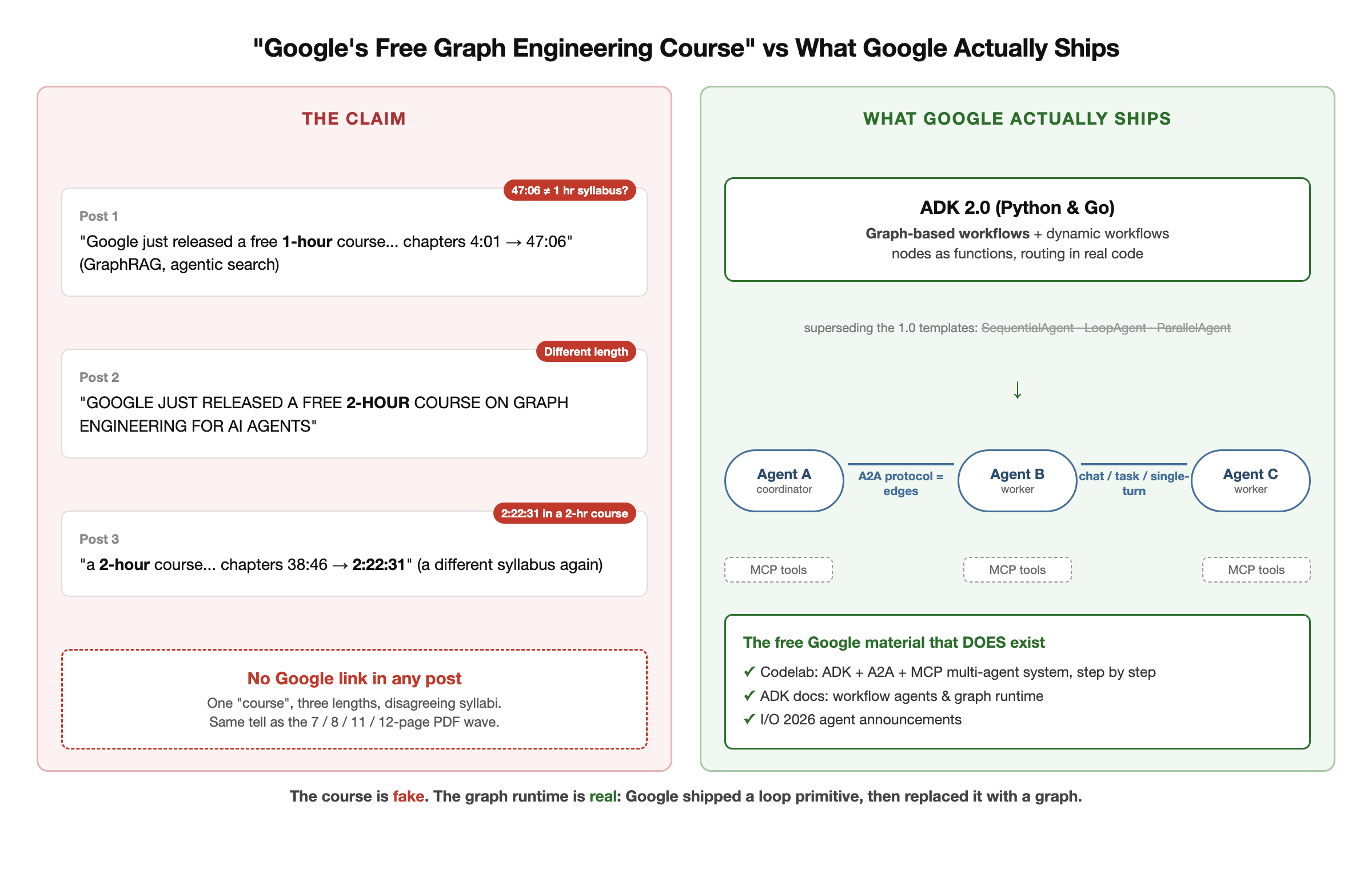
Through late July and early August 2026, a cluster of posts pushed the same headline. "Google just released a free 1-hour course to master graph engineering from 0% to 100%," wrote @Av1dlive, with chapter timestamps at 4:01, 15:00, 30:00, 35:48, and 47:06. "GOOGLE JUST RELEASED A FREE 2-HOUR COURSE ON GRAPH ENGINEERING FOR AI AGENTS," megaphoned an aggregator account with six-figure reach. "Google just released a 2-hour course on building agentic knowledge graphs from scratch," wrote @AnatoliKopadze, listing chapters at 38:46, 54:46, 1:12:43, 1:20:57, and 2:22:31.
Read those again as one catalog and the story falls apart on its own arithmetic:
- The course is one hour in some posts and two hours in others. Same claim, same week, same "Google just released."
- The 2-hour version's own chapter list runs to 2:22:31. A two-hour course with a chapter starting past two hours and twenty minutes.
- The syllabi disagree about what the course teaches. One map is GraphRAG, agentic search, and self-improving graph agents. Another is "prompt to agents to loops to graphs to multi-agent systems." These are different courses.
- None of the posts links a Google property. No YouTube channel owned by Google, no Google Cloud Skills page, no codelab, no developer blog.
We ran the same check on real documents in the Karpathy PDF wave and the Andrew Ng PDF wave: when the same artifact is described with different page counts, or here different runtimes, nobody is looking at the same file, because there is no file. Real courses do not change length between posts. As of 2026-08-11, searching Google's developer, cloud, and education properties for a graph engineering course returns nothing by that name.
Where "Google" Entered the Story
Misattributions like this usually have a germ, and this one is findable.
The real course closest to the viral framing is Agentic Knowledge Graph Construction on DeepLearning.AI. It is taught by Andreas Kollegger, who leads GenAI Innovation at Neo4j. It runs 3 hours 8 minutes across 12 lessons, it is free while the platform is in beta, and, this is the key detail, it builds its multi-agent system with Google's Agent Development Kit. Agents built with Google ADK construct knowledge graphs in Neo4j from CSVs and text.
So a Neo4j instructor teaching on Andrew Ng's platform using Google's toolkit becomes, after two retellings, "Google just released a free course." The same wave attributes it to Ng in other posts. The tell survives in the vocabulary: the claimed syllabi that mention GraphRAG and agentic search are knowledge-graph content, and a knowledge graph is not an agent graph. One stores facts as entities and relationships. The other wires agents into nodes with routed edges and shared state, which is what graph engineering names. The course is real and worth your time if your bottleneck is data. It is not Google's, and it is not about agent orchestration.
If you want the fuller version of how this packaging pattern works, we graded it twice already: the 11-page "Anthropic" PDF whose own cover disclaims Anthropic, and the 8-or-12-page Ng PDF that changes length between posts. Public work gets wrapped in famous provenance because the provenance is what makes it spread.
Free AI Builder Newsletter
Weekly guides on AI tools & builder strategies.
What Google Actually Ships
Here is the part the viral posts could have written truthfully, because it is more interesting than the fake course.
Google's Agent Development Kit is its open-source, code-first framework for multi-agent systems, and its docs describe orchestrating "complex tasks through structured, graph-based architectures." Python ADK hit v1.0.0 as production-ready at I/O 2025. Version 1.0 shipped three template workflow agents: a sequential agent that runs sub-agents one after another, a loop agent that repeats sub-agents until a termination condition is met, and a parallel agent that fans out.
Then ADK 2.0 arrived in 2026, and the workflow-agents documentation now says the quiet part plainly: the templates are superseded. Starting in ADK 2.0 for Python and Go, you build graph-based workflows and dynamic workflows instead. Per Google Cloud's I/O 2026 post, dynamic workflows are built with decorators, workflow nodes are invoked as functions, and routing logic uses the full programming language rather than a fixed template. Collaborative Workflows added three explicit modes for a coordinator delegating to sub-agents: chat, task, and single-turn. Underneath it all, the A2A protocol (v0.2 as of I/O 2025, with stateless interactions and standardized auth) is the interoperability layer, the edges between graphs owned by different teams.
Notice what that sequence is. Google shipped a loop primitive, found it insufficient for the coordination problems its users actually had, and replaced it with a graph runtime. That is the loop-to-graph transition executed inside one framework's version history, by the company the fake course is attributed to. The viral posts invented a Google course about graph engineering while missing that Google's real framework had just made the graph its primary abstraction.
Two honest caveats. Google has never used "graph engineering" as a product, course, or discipline name; the term came out of the July 2026 X discourse, and mapping ADK's features onto it is our synthesis. And ADK is one implementation among several: LangGraph and AutoGen's GraphFlow got to the same shape earlier, which we compare head-to-head in Is Graph Engineering Just LangGraph?
The Free Google Material That Does Exist
If the fake course had a real referent, it would be this list. All free, all actually Google's:
- Google's Agent Stack in Action codelab, which walks you through wiring a multi-agent system with ADK, A2A, and MCP on Google Cloud. Hands-on, step-by-step, and the closest existing thing to "Google's graph engineering course."
- The ADK docs, whose workflow-agents and A2A sections are short enough to read in a sitting and are the primary source for everything above.
- The I/O 2026 agent announcements, which are the fastest way to see where Google thinks agent development is going: managed agents, an interactions API, and graphs as the default workflow shape.
What To Do Next
The honest ordering, if the search that brought you here was really "how do I learn this":
- Decide which graph you mean. Facts in a database is the knowledge-graph course. Agents coordinating work is graph engineering, and it is the sense almost all 2026 search demand carries.
- Do the real free material. The codelab above for Google's stack, or our graph engineering guide for the framework-agnostic architecture: nodes, edges, state, routing, and the test for when a graph is worth its complexity.
- Check provenance before you repeat it. Two contradictory runtimes for the same course is the same tell as two contradictory page counts for the same PDF. Thirty seconds of checking whether any post links a Google page would have killed this one.
Related Content
- Graph Engineering: The Complete Guide for 2026 - The pillar. Nodes, edges, shared state, routing, and when a graph is worth its complexity.
- Is Graph Engineering Just LangGraph? LangGraph vs AutoGen vs Google ADK - The framework comparison, including where ADK fits and what A2A adds.
- Graph Engineering vs Loop Engineering - The transition Google's own framework just executed, and which side your bottleneck is on.
- Graph Engineering and the Karpathy Loop - The same borrowed-provenance pattern, PDF edition, with the real loop underneath it.
- Andrew Ng's Agentic Patterns, Mapped Onto Agent Graphs - The Ng version of the wave, and the real four patterns under the fake PDF.
Start Here
If you came here hunting a free Google course, the better version of that is a course that makes you build the thing instead of watch it.
The Loop Engineering course starts where Google's own framework history says to start: one agent with a real verifier and an explicit stop condition, the unit you later drop into a graph as one node. Verifier first, then the second agent, then the graph. By the time you wire agents into ADK's graph workflows or LangGraph, you know what each node has to prove.
For node and edge templates, and for teardowns of course claims that spread faster than their receipts, join the AI Builder Club and come ship something real.
Frequently Asked Questions
Did Google release a free graph engineering course?
No. As of 2026-08-11 there is no course named or described as graph engineering on any Google property. The viral posts claiming one contradict each other: the same course is described as 1 hour in some posts and 2 hours in others, one 2-hour version's own chapter list runs to 2:22:31, and the syllabi disagree about what the course even covers. None of the posts we checked links a Google page.
What is the free course the posts are actually pointing at?
The real course closest to the viral framing is DeepLearning.AI's Agentic Knowledge Graph Construction, taught by Andreas Kollegger of Neo4j. It runs 3 hours 8 minutes, it is free during the platform's beta, and it builds its multi-agent system with Google's Agent Development Kit. Google's toolkit appears inside the course, which is probably how 'Google' entered the story. The course itself is not a Google publication, and it teaches knowledge graphs, which is a different discipline from agent graph engineering.
Does Google actually do graph engineering?
Yes, in its frameworks rather than in a course. Google's Agent Development Kit orchestrates agents through graph-based architectures, and ADK 2.0 for Python and Go superseded its old sequential, loop, and parallel workflow templates with graph-based workflows and dynamic workflows. The A2A protocol handles agent-to-agent delegation across systems. Google ships graph engineering tools; it has never used the term as a product or course name.
What is the difference between a knowledge graph and an agent graph?
A knowledge graph stores facts as entities and relationships, and is a data structure agents can read and write. An agent graph wires agents themselves into nodes with routed edges and shared state, and is an architecture for coordinating work. The viral posts blur the two: several of the claimed syllabi are knowledge-graph content relabeled as graph engineering. Most 'graph engineering' search intent in 2026 means the agent-architecture sense.
Where should I actually learn graph engineering?
Free and real: Google's own codelab wiring a multi-agent system with ADK, A2A, and MCP, and DeepLearning.AI's knowledge-graph course if your bottleneck is data rather than orchestration. For the architecture discipline itself, our graph engineering guide covers nodes, edges, state, and routing, and the AI Builder Club course track walks you from one verified loop to a coordinated graph.
Sources & Verification
On 2026-08-11 we searched Google's developer, cloud, and education properties for a course named or described as graph engineering and found none. The viral posts claiming one were read directly; the receipts quoted here are their own contradictions in course length and syllabus. Google's real capabilities are verified against Google's own materials: the ADK workflow-agents documentation, the I/O 2025 developer blog post (ADK 1.0, A2A v0.2), and the Google Cloud I/O 2026 post (ADK 2.0, Dynamic Workflows, Managed Agents API). The DeepLearning.AI course we identify as the likely germ of the misattribution was checked on its own course page. The mapping from ADK's features to graph engineering vocabulary is AI Builder Club's synthesis, not Google's framing. See our editorial standards.
- Post claiming a free 1-hour Google graph engineering course (@Av1dlive) - Claims 'Google just released free 1-hour course to master graph engineering from 0% to 100%', with chapter timestamps ending at 47:06. Links no Google property.
- Post claiming a 2-hour Google course on agentic knowledge graphs (@AnatoliKopadze) - Claims a '2-hour course' whose own chapter list runs to 2:22:31. A different syllabus from the 1-hour version.
- Post claiming a free 2-hour Google course on full graph engineering (@LunarResearcher) - The same account posted the 1-hour knowledge-graph version twelve days earlier with a different chapter map.
- ADK workflow agents documentation (adk.dev) - The three template workflow agents (sequential, loop, parallel) and the note that starting in ADK 2.0 for Python and Go they are superseded by graph-based workflows and dynamic workflows.
- What's new with Agents: ADK, Agent Engine, and A2A Enhancements (Google Developers Blog, I/O 2025) - Python ADK v1.0.0, Java ADK v0.1.0, A2A protocol v0.2 with stateless interactions and standardized authentication.
- I/O '26 news for agent developers on Google Cloud (Google Cloud Blog) - ADK 2.0: Collaborative Workflows with chat, task, and single-turn modes; Dynamic Workflows built with decorators and workflow nodes invoked as functions; ADK Kotlin beta; Managed Agents API.
- Agentic Knowledge Graph Construction (DeepLearning.AI) - The real course closest to the viral framing: taught by Andreas Kollegger, who leads GenAI Innovation at Neo4j. 3 hours 8 minutes, free during the platform's beta, and it builds its multi-agent system with Google's ADK. Not a Google publication.
- Google's Agent Stack in Action: ADK, A2A, MCP on Google Cloud (Google Codelabs) - The closest thing to a free Google-authored graph engineering course that actually exists: a hands-on codelab wiring a multi-agent system with ADK, A2A, and MCP.
- Graph Engineering Guide (AI Builder Club) - Our definitions for nodes, edges, shared state, and routing, and when a graph is worth the complexity
Join AI Builder Club


$37/mo
Get the free newsletter
Weekly deep-dives on AI tools, automation workflows, and builder strategies. Join 5,000+ readers.
No spam. Unsubscribe anytime.