Loop Engineering Case Study: 30 Days of Real Data (2026)
An agent loop flagged 'loop engineering' as a trend, another loop wrote the articles, and GSC verified. 30 days, 57,470 impressions - every number published.
Course outline · Build AI Agents (4.15)
On June 16, 2026, an agent loop running against a markdown wiki flagged "loop engineering" as an emerging topic - score 90/100 - before we'd ever considered writing about it. Twenty-four hours later a pillar article was live. Thirty days later that page had 57,470 impressions, 845 clicks, and a daily agent loop shipping supporting articles around it. This is the full run log: every number, including the runs that failed.
Our loop engineering guide makes an argument: the leverage has moved from writing prompts to designing loops, and the verifier - not the model - is the bottleneck. Plenty of people have made that argument. What almost nobody publishes is operational data from actually running loops. The top-ranking explainers for this topic average about four unique figures per page, most of them quoted from the same two essays.
So this article is the counterweight: a case study of two production loops - a content radar loop that discovers topics and a SEO engine loop that writes and ships articles - run on our own business for 30 days, with the numbers straight from the logs.
The System: Two Loops and a Wiki
The architecture is the "artifacts, contracts, and logs" file system the pillar describes, made concrete. Everything is plain markdown with frontmatter, in git.
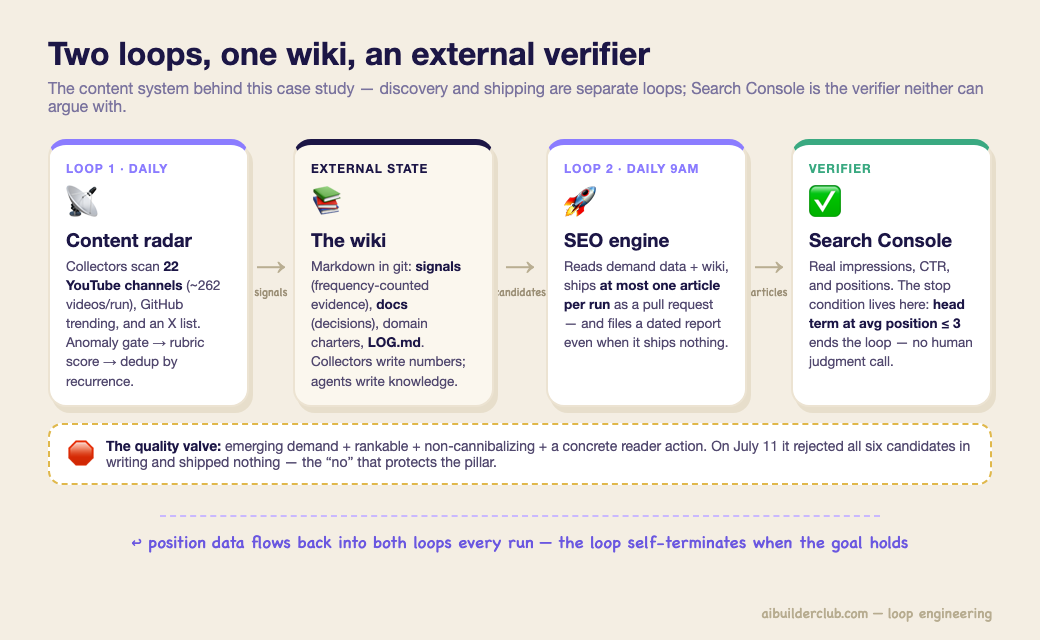
The wiki has exactly two artifact kinds - signals (evidence: ideas and observations, deduplicated and frequency-counted) and docs (durable knowledge: decisions and analyses). Loops live in domain folders that hold only a charter README and machinery (a source watchlist, a rules file, metrics/*.jsonl written by deterministic collectors). A root LOG.md gets one line per ship. That's the whole schema. If you've read Addy Osmani's five components - automations, worktrees, skills, connectors, subagents, plus external state - this wiki is the external state, and the rest of the system maps one-to-one onto the other five.
Two design rules do most of the work:
- Collectors write numbers; agents write knowledge. View counts, star velocities, and search positions come from scripts, not from a model's impression of them. The LLM's job is judgment against a written rubric, never data entry.
- Recurrence is a signal, not a duplicate. When a topic shows up again, the loop bumps a
frequencycounter on the existing signal file and appends a dated line to its timeline. Frequency became the single most predictive field in the system, as you're about to see.
Day 0: The Radar Loop Catches the Keyword
The radar loop's charter is push-by-source discovery: scan a fixed watchlist - 22 YouTube channels (roughly 262 videos per run), GitHub trending, and a curated X list - for items that are new, anomalous, and practical, before they're obvious.
On June 16, its first real run, five items about the same unnamed idea surfaced within a 48-hour window:
| Source | Item | Anomaly signal |
|---|---|---|
| YouTube (AILABS) | "Loop Engineering Totally 10x Hermes agents" | 9.8k → 22k views mid-scan |
| X (@samueljmcd) | "My Thoughts on Loop Engineering" | 411 engagements |
| YouTube (DevelopersDigest) | "Loop Engineering in 9 Minutes" | 18.8k views |
| YouTube (01coder30, Chinese) | "Loop Engineering 循环工程" | 6.07x the channel's baseline views |
| X (@dotey retweet) | A counter-take: "coining new words for clout" | live counter-narrative |
The screening rubric scored the cluster 90/100 and wrote one signal file: cross-platform recurrence plus an already-forming backlash meant a term being coined right now. The same run's rubric killed two higher-traffic clusters as hype - a model-ban news cycle and a model-drama cycle that dominated the raw view-anomaly list. That rejection is the detail worth copying: the loop's value that day was as much what it refused to surface as what it flagged.
The next day the term recurred - frequency bumped from 3 to 5, and the Chinese-language hit showed it crossing scenes. Two days later the signal's timeline logged a community artifact forming around the term (a curated loop library at 1.8k likes). Three independent confirmations, three days, zero human browsing.
Day 1-14: Signal to Page One
The pillar - Loop Engineering: Stop Writing Prompts, Start Writing Verifiers - was published June 17, about 24 hours after the signal file was written. Search Console recorded its first impressions the same day: 3 impressions at position 5.
Then Google did what Google does with new pages on new terms:
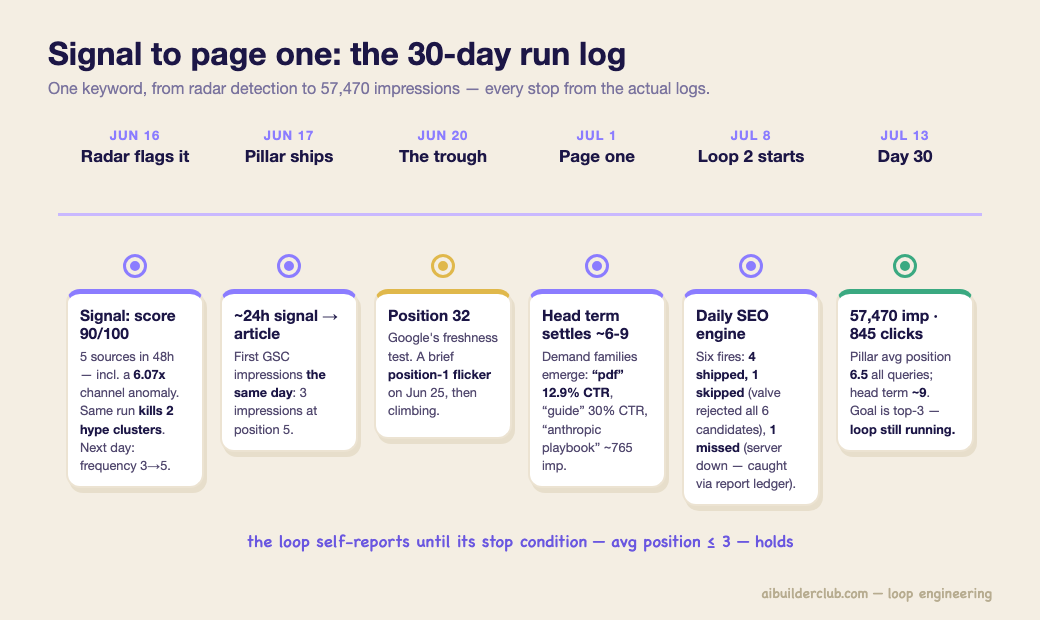
- June 20: position 32 on the head term - the freshness test trough.
- June 25: a brief position-1 flicker (14 impressions that day).
- July 1: settled onto page one, position ~6 on the head term.
- July 11 (day 24): cumulative pillar totals across all queries: 57,470 impressions, 845 clicks, average position 6.5.
The 30-day query-level picture on the pillar, from the Search Console API:
| Query | Impressions | Clicks | CTR | Avg position |
|---|---|---|---|---|
| loop engineering (head term) | 1,288 | 38 | 3.0% | 9.0 |
| loop engineering pdf | 286 | 37 | 12.9% | 4.8 |
| loop engineering course | 235 | 20 | 8.5% | 3.6 |
| "anthropic playbook" family (7 variants) | ~765 | 26 | 3.4% | 7-12 |
| loop engineering tutorial | 132 | 17 | 12.9% | 4.4 |
| loop engineering guide | 70 | 21 | 30.0% | 2.3 |
Two things in that table drove everything the system did next. The "pdf" row is demand we never wrote for - a lead magnet the audience asked for by searching. And the "anthropic playbook" family is what a query family looks like before you serve it: hundreds of impressions spread across seven phrasings, all landing on a page that only partially answers them.
Free AI Builder Newsletter
Weekly guides on AI tools & builder strategies.
Day 21+: The SEO Engine Loop (and What It Refused to Ship)
On July 8 we wrapped the follow-through in a second loop: a daily 9am agent that reads the wiki and Search Console, decides whether exactly one supporting article clears a quality bar, and ships it as a pull request - with a written report either way. It's a goal-based loop in the pillar's vocabulary: its stop condition is "head term at average position ≤ 3," checked against GSC every run, and it terminates itself when that holds.
Six scheduled fires in, the ledger reads: 4 shipped, 1 skipped, 1 missed.
The four ships were the Anthropic playbook, the Karpathy lineage, the four loop types, and Addy Osmani's five components - each targeting a query family the pillar was absorbing at low CTR.
The skip is the run worth studying. On July 11 the loop evaluated six candidates and rejected all of them, in writing:
| Candidate | Rejection | Reason from the run report |
|---|---|---|
| Andrew Ng angle (~300 imp forming) | Cannibalization | Pillar already owns a dedicated section + FAQ on it |
| Doom loops / failure modes | Cannibalization | The loop-types article shipped 24h earlier owns it |
| Compounding engineering | No demand | 0 GSC rows - speculative |
| Self-improving loops | Thin | Only noise from an already-rejected cluster |
| How to write a verifier | Too close to pillar | It's the pillar's core thesis |
| Osmani angle | Deferred | 1 impression - "a fluke, not a forming cluster" |
"Forcing a page would be thin or splitting - which actively hurts the pillar - so nothing shipped." That sentence is the quality valve doing its job, and it's the difference between loop engineering and a content farm with a cron job. Scaled templated output without a working "no" is the exact pattern that got sites cut 30-49% in Google's January 2026 update.
Two days later the deferred Osmani candidate flipped to a ship - because of a measurement bug worth confessing.
The Failure Log
First-party data cuts both ways. From the same 30 days:
- The exact-substring bug. The July 11 run measured demand for the Osmani angle with an exact substring match and saw 1 impression. The July 13 run queried the whole phrase family and found ~1,930 impressions over 19 straight days - flowing the entire time, at 0.05% CTR, to a pillar that doesn't cover the topic. The demand was never small; the query was wrong. If your verifier reads a metric, the metric's definition is part of the verifier - a one-token measurement bug produced a wrong no-ship verdict for two days.
- A missed fire. The July 12 run never happened - the scheduling server was down. The July 13 run detected the gap from the report ledger and covered it. External state (dated reports on disk) is what made the gap visible; a loop whose runs leave no artifact can't even know it missed one.
- A dead cron. The radar loop's launchd job errored on June 25 and the loop went quiet for a stretch - discovered later from an error log, not an alert. Triggers fail silently; monitoring the trigger is part of the loop.
- The goal isn't met. The whole system exists to put the pillar in the top 3 for the head term. At position ~9, flat for two weeks, it isn't there - and the loop's own July 11 report said the honest thing: the cluster is saturating, and the next positions will come from off-site authority, not from more articles. A well-designed loop tells you when it is no longer the highest-leverage tool.
What the Data Says Loop Engineering Actually Bought
Strip the story and five findings survive:
- Discovery latency is the real product. Signal to published pillar in ~24 hours, first impressions the same day. Every competing page on this term was reacting to the same June essays; the radar loop's anomaly detection just reacted measurably earlier - and early pages compound impressions while late ones queue for crawl.
- Frequency-counting beats scoring. The rubric's 90/100 got attention, but recurrence (frequency 3 → 5 across platforms and languages in 48 hours) was the trustworthy buy signal - and it emerged mechanically from dedup, no judgment required.
- The verifier earns its keep on the "no." Six candidates, six written rejections, zero thin pages. One skip protected a 57k-impression asset from cannibalization worth more than any single new article.
- Search Console is a verifier you don't have to build. Every ship decision was checked against real demand data before and after. The loop's stop condition is a GSC number. When people ask what "external verification" looks like outside a test suite, this is it.
- Person-attached and format-attached demand is where the CTR is. The head term gets 3.0% CTR at position 9; "guide," "tutorial," and "pdf" queries get 12-30%. The cluster articles the loop chose all chase named-person or named-format families - because that's where the table said the unmet intent was.
Steal the System
You don't need our stack - the shape is five components and a wiki, and you can assemble it in an afternoon from the loop engineering guide's checklist:
- A markdown knowledge base with two kinds (signals, docs), domains-as-loops, and one global log. Deterministic collectors write numbers; agents write judgment.
- A discovery loop on a source watchlist with anomaly detection, a written rubric, and dedup-by-recurrence.
- A shipping loop with a hard quality valve, one-artifact-per-run, PRs instead of direct pushes, and a dated report especially when nothing ships.
- An external verifier (for content, Search Console; for code, tests and CI) wired into a stop condition, so the loop knows what "done" means without you.
Writing that stop condition from scratch for your own loop? The AI Agent Loop Builder generates a starting kit for your task type - a verifier checklist, a round cap, a budget cap, and doom-loop tripwires - in seconds.
If you'd rather build it guided, with the collectors, rubrics, and report templates from this exact system, that's what the Loop Engineering course is - the wiki architecture, both loops, and the verifier patterns, taught end to end.
Related Reading
- Loop Engineering: Stop Writing Prompts, Start Writing Verifiers - the pillar this system was built to prove
- The 4 Types of Agentic Loops - where the goal-based SEO loop fits
- Addy Osmani's Loop Engineering: The 5 Components - the parts list this system implements
- Loop Engineering: The Anthropic Playbook - the gather-act-verify cycle each run executes
- Loop Engineering vs Harness Engineering - which layer the wiki and the valve each live in
Frequently Asked Questions
What is a real example of loop engineering?
This article documents one end to end: a daily radar loop that scans 22 YouTube channels, GitHub trending, and X for emerging builder topics and writes deduplicated, frequency-counted signals to a markdown knowledge base; and a daily SEO loop that reads Google Search Console demand data, decides whether a new article clears a quality bar, and ships it as a pull request - or refuses to ship. Over 30 days the pair took one detected keyword from zero to 57,470 impressions and 845 clicks.
How long did it take a brand-new keyword page to rank?
The pillar article recorded its first Google impressions the day it was published (June 17, 2026 - 3 impressions at position 5), briefly spiked deep to position 32 as Google tested it, and settled on page one within about two weeks. Thirty days in it averaged position 6.5 across all queries and position ~9 on the head term - real, but short of top-3, which is why the loop that tracks it hasn't declared itself finished.
What is a content radar loop?
A push-by-source discovery loop: deterministic collectors pull recent items from a fixed watchlist (YouTube channels, GitHub trending, X lists), compute view-count anomalies against each channel's baseline, an LLM scores survivors against a written rubric, and results are deduplicated against existing signals by title and URL - recurrence increments a frequency counter instead of creating duplicates. Its job is to surface topics you didn't know to search for, before they saturate.
What does a quality valve do in a content loop?
It's the verifier half of the loop: a set of written gates (emerging demand in Search Console, rankable, non-cannibalizing, and a concrete next action for the reader) that every candidate article must clear. On July 11 our SEO loop evaluated six candidates, rejected all six with written reasons, and shipped nothing. A loop that can't say 'no ship' isn't engineered - it's just a content farm with a cron job.
Why publish the numbers if the goal isn't met yet?
Because the loop's own logs are the most useful artifact it produces. The system's goal is top-3 on the head term; at position ~9 it isn't there. Publishing the full run log - including a missed fire, a broken cron, and a measurement bug - is what makes the wins credible, and the failure modes are where most of the transferable lessons live.
Sources & Verification
Every number in this article comes from three first-party sources: (1) the Google Search Console API for the property aibuilderclub.com, pulled 2026-07-13 (GSC data lags ~2 days, so ranges end 2026-07-11; positions are averages across all impressions, which is why they move non-monotonically); (2) the git history and signal files of the markdown knowledge base ('the wiki') our radar loop writes to; (3) the dated run reports our SEO loop files after every fire, including the runs where it shipped nothing. Nothing is projected, sampled, or modeled. Failures are reported alongside wins. See our editorial standards.
- Loop Engineering: Stop Writing Prompts, Start Writing Verifiers (AI Builder Club) - The pillar article this case study is the living evidence for - and itself the first artifact the system produced
- Google Search Console API - The verifier of record: all impression, click, CTR, and position data
- Loop Engineering: Designing loops that prompt coding agents (Addy Osmani) - The essay that named the discipline; our system independently implements his five components, which we note where relevant
- My 3 key loops for building 0-to-1 products (Andrew Ng, The Batch) - The nested-loops model; our system is his three loops with the middle one on a daily cadence
Join AI Builder Club


$37/mo
Get the free newsletter
Weekly deep-dives on AI tools, automation workflows, and builder strategies. Join 5,000+ readers.
No spam. Unsubscribe anytime.