Andrej Karpathy and Graph Engineering: What's Actually Real
A viral post says two Anthropic seniors made Andrej Karpathy's loop 1000x better with graph engineering. The 11-page PDF's own cover disclaims both names.
Course outline · Build AI Agents (4.26)
If you searched "karpathy graph engineering" in the last two weeks, you probably arrived from one specific post. On 2026-07-24, @0xCodila wrote that "two Anthropic seniors just made Karpathy's loop 1000x better with 'Graph Engineering'" and "dropped 11-page PDF." It has 3,455 likes and 473,288 views as of this writing, and it ends with "read this 11-page PDF and paste it into your Claude." The post's immediate self-reply links the file.
So people are searching for the PDF. The file is real. Its claimed provenance is not.
Short version: the loop is real and you can read the code today. The 11-page PDF is real too, but it is not an Anthropic publication. Its cover says it was independently compiled and is not affiliated with or endorsed by Anthropic or Karpathy. The six-step playbook is mostly sound engineering advice assembled from public sources, not something two Anthropic seniors published. Those three facts are worth separating, because the useful part survives the correction.
For the vocabulary underneath all of this, our graph engineering guide is the pillar. This piece is the Karpathy-shaped door into it.
What Karpathy Actually Published
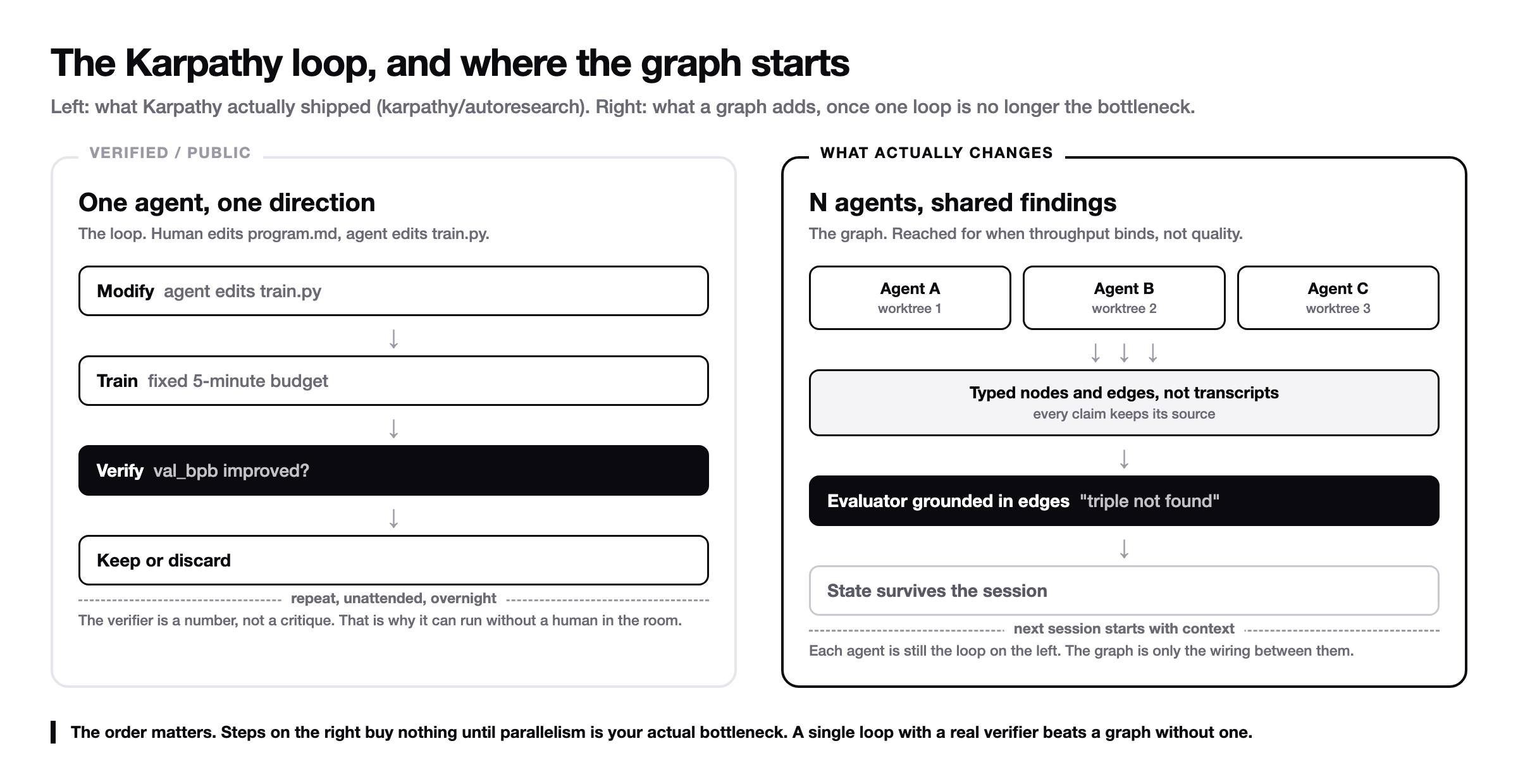
Karpathy's loop is not a metaphor or a leaked document. It is a repository. karpathy/autoresearch went up in March 2026 and sits at 92,341 stars as of 2026-07-30, and the README describes the mechanic in one sentence:
"The idea: give an AI agent a small but real LLM training setup and let it experiment autonomously overnight. It modifies the code, trains for 5 minutes, checks if the result improved, keeps or discards, and repeats."
That is the Karpathy loop, stated by Karpathy. Three details in the repo matter more than the tweet thread built on top of it:
The loop has a real verifier, and it is cheap. Training runs on a fixed five-minute wall-clock budget and the metric is val_bpb, validation bits per byte. Lower is better, and it is vocab-size independent so architectural changes compare fairly. This is the whole reason the loop can run unattended: a wrong answer is caught by a number, in five minutes, without a human reading anything.
Only one file is agent-editable. prepare.py is fixed. train.py is the single file the agent edits, and everything in it is fair game. That boundary is what keeps an overnight run from wandering.
The human programs the instructions, not the code. As the README puts it, "you are programming the program.md Markdown files that provide context to the AI agents and set up your autonomous research org." The human's artifact is the program the agent runs on. This is the part most summaries of autoresearch drop, and it is the part that generalizes to everything else you will build.
His earlier positions line up with this exactly: the generation-verification loop, keeping AI on a leash, and the autonomy slider from his Software 3.0 keynote. We traced those in Loop Engineering, Karpathy-Style. Nothing in the July graph wave contradicts them.
What the Linked PDF Actually Is
The viral post claims a specific provenance: an 11-page PDF from two Anthropic seniors. Here is what checking the link and the file turned up.
The post's immediate self-reply links Graph-Engineering-Anthropic-Karpathy-Loop.pdf, and the file is 11 pages. The cover calls it "The Anthropic Playbook" and carries an Anthropic mark. The same cover also prints the decisive receipt: it was independently compiled and is not affiliated with or endorsed by Anthropic or Karpathy. This is not an absent artifact. It is an independent compilation presented in the surrounding post as Anthropic work.
Anthropic's published material as of 2026-07-30 contains no graph engineering PDF, discipline, or product by that name. The linked PDF's own disclaimer supports that conclusion. Other viral versions make different claims: a 7-page PDF on the same topic by a named Anthropic engineer, then 8-page and 12-page versions of Andrew Ng's loop-to-graph story, which we documented in Andrew Ng's agentic patterns, mapped onto graphs.
Those differing page counts do not show that this 11-page file is invented. They show a broader pattern: public ideas get packaged into short PDFs and promoted with famous institutional provenance. Here the receipt is inside the file. The PDF exists, and its cover contradicts the Anthropic attribution attached to it.
We are not calling the ideas fake. We are saying the provenance is, and it matters which one you repeat. If you paste "the Anthropic graph engineering playbook" into a design doc, you are attributing your architecture to Anthropic even though the document disclaims that affiliation on its cover.
The "1000x" figure deserves the same treatment. It is not a benchmark from anywhere. In the post it is applied to agentic systems in general, and no measurement accompanies it.
Free AI Builder Newsletter
Weekly guides on AI tools & builder strategies.
The Six Steps, Graded
The post's actual content is a six-step ladder. Stripped of the fake provenance, most of it is advice we would give, and one step is doing more work than it looks. Here it is with our own attribution, and our own reservations.
Step 1, build one loop: generate, critique, revise. Correct, and it is the step people skip. The post's phrasing is "one self-review cycle beats a smarter model with none," which is the same claim autoresearch demonstrates with val_bpb. The caveat: self-critique by the same model is the weakest form of verification available. Karpathy's loop does not self-critique, it measures. If you can replace a critique step with a number, do.
Step 2, add tools. Fine, and unremarkable by mid-2026. Search, code execution, a database. "Thinking without tools is hallucinating" is overstated but points somewhere true: an agent that cannot check the world will confidently describe a version of it that does not exist.
Step 3, go parallel in separate worktrees. This is the real hinge, and it is the step that actually turns a loop into something that needs a graph. Separate git worktrees, same repo, different branches, no write conflicts. This is also what Karpathy's own README gestures at when it notes that it is "obvious how one would iterate on it over time," including "how you'd add more agents to the mix." The moment there are several agents, you have a coordination problem you did not have before.
Step 4, agents write findings as typed nodes and edges, not transcripts. This is the graph, and the framing is good. A transcript is append-only prose that the next agent has to re-read and re-interpret; a typed node keeps its claim and its source separately addressable. Our agent graph definitions cover the shape.
Step 5, ground the evaluator in graph edges. The strongest step in the list. An evaluator that reports "triple not found" is debuggable; one that reports "seems off" is not. This is step 1's verifier, rebuilt so it works when the thing being checked was produced by five agents instead of one.
Step 6, the graph survives the session. Persistence, so agents stop rebuilding context from scratch. Right, and the most under-built part of most setups we see.
Where we would push back on the ladder as a whole: it reads as a progression every project should climb, and it isn't. Steps 4 through 6 buy you nothing until step 3 is actually your bottleneck. Plenty of production agent work is one loop with an excellent verifier, and adding typed nodes to it is cost without return. Our guide has the when to reach for a graph test, and "my loop works but I need five of them at once" is the honest trigger.
So What Changed in July?
Not the engineering. The vocabulary.
Karpathy shipped a loop with a five-minute verifier in March. The techniques in the July playbook, parallel worktrees, typed shared state, grounded evaluators, persistent memory, were all available and in use before anyone attached "graph engineering" to them. What happened in July is that the community found a name for the multi-agent case, and a wave of posts attached that name to famous people and institutions. The linked PDF is the cleanest receipt: its cover disclaims the Anthropic and Karpathy provenance that the surrounding post supplies.
That is worth knowing precisely because the underlying shift is real. If you are running one agent in one direction and hitting a wall on throughput rather than quality, the graph is the right next move. If you are hitting a wall on quality, it is not, and no playbook will change that.
What To Do Next
The honest ordering, if you want the thing the PDF was supposed to give you:
- Make your verifier a number. If you cannot state your agent's success condition as something a script checks in under five minutes, that is this week's work. Everything else is premature.
- Write the
program.md. Not a prompt. The instructions your loop runs on, that you edit and version while the agent edits the code. - Only then add the second agent, and when you do, decide where shared findings live before you spawn it.
Steps 1 and 2 are loop work, and they are where almost everyone actually is. Step 3 is where graph engineering begins.
Related Content
- Graph Engineering: The Complete Guide for 2026 - The pillar. Nodes, edges, shared state, routing, and when a graph is worth its complexity.
- Loop Engineering, Karpathy-Style - The loop-side companion. Generation-verification, the leash, the autonomy slider.
- Andrew Ng's Agentic Patterns, Mapped Onto Agent Graphs - The same borrowed-authority pattern, with the real patterns underneath it.
- Graph Engineering with Claude Code - Subagents as nodes, worktrees in practice, with the tool you already have open.
- Graph Engineering vs Loop Engineering - Which one your current bottleneck actually calls for.
Start Here
If you got here hunting a PDF to paste into Claude, the better version of that is a course that makes you build the thing.
The Loop Engineering course walks this ladder in order: a single agent with a real verifier and an explicit stop condition, which is the unit you later drop into a graph as one node. Verifier first, then the second agent, then the graph, with code you run rather than provenance you borrow.
For node and edge templates, and for teardowns of the architecture claims that spread faster than their receipts, join the AI Builder Club and come ship something real.
Jason made this exact point about AutoResearch in our August 2 workshop: it is a graph with no nodes and no edges, just a text file describing the SOP next to a log of everything already tried. Watch the session.
Frequently Asked Questions
Did Andrej Karpathy invent or endorse graph engineering?
No. Karpathy has not used the phrase graph engineering, in the same way he never used loop engineering. What he published is a loop: autoresearch, where one agent edits a training file, runs a fixed 5-minute experiment, keeps or discards the result, and repeats. The graph vocabulary was applied to his work by other people, including us.
Is there an 11-page Anthropic graph engineering PDF?
There is an 11-page PDF, but it is not an Anthropic publication. The viral X post's immediate self-reply links Graph-Engineering-Anthropic-Karpathy-Loop.pdf. Its cover calls it 'The Anthropic Playbook' but also says it was independently compiled and is not affiliated with or endorsed by Anthropic or Karpathy. The document exists. The claimed Anthropic provenance does not.
What is the Karpathy loop?
Shorthand for the cycle Karpathy has described and shipped: generate, verify, keep or discard, repeat. In autoresearch it is literal. An agent modifies train.py, trains for five minutes, compares validation bits per byte, and keeps the change only if the metric improved. The human does not edit the Python; the human edits program.md, the instructions the agent runs on.
How does the Karpathy loop become a graph?
You reach for a graph when one loop stops being the bottleneck and coordination does. Karpathy's own README points at the first step: add more agents to the mix. Once several agents run at once, you need somewhere shared to put their findings, a way to route work between them, and an evaluator that checks claims rather than vibes. Those are nodes, edges, and state, which is what graph engineering names.
Should I build a graph or fix my loop first?
Fix the loop. A single loop with a real verifier beats a graph with none, and most agent setups fail at verification, not topology. The ladder in this article is deliberately ordered so that the graph arrives last, once you have something worth running a thousand times.
Sources & Verification
Karpathy's autoresearch repository and its README are the primary source for how his loop works; we read the repo directly and recorded its star count on 2026-07-30. His generation-verification loop and autonomy slider come from his Software 3.0 keynote. The claim that two Anthropic seniors published an 11-page graph engineering PDF comes from an X post whose immediate self-reply links the file. We checked the 11-page PDF directly. Its cover says it was independently compiled and is not affiliated with or endorsed by Anthropic or Karpathy. Anthropic's public materials as of 2026-07-30 contain no graph engineering publication, discipline, or product by that name. The mapping from Karpathy's loop to graph vocabulary is AI Builder Club's synthesis, not Karpathy's framing. See our editorial standards.
- karpathy/autoresearch (GitHub) - The real loop: an agent edits train.py, trains for a fixed 5-minute budget, checks val_bpb, keeps or discards, repeats. 92,341 stars as of 2026-07-30. The README is also where Karpathy notes that adding more agents to the mix is an obvious next iteration.
- Andrej Karpathy: Software Is Changing (Again) - Software 3.0 (Latent Space writeup) - The generation-verification loop, keeping AI on a leash, and the autonomy slider
- Post claiming an 11-page Anthropic graph engineering PDF (@0xCodila) - 3,455 likes and 473,288 views as of 2026-07-30. Claims two Anthropic seniors made Karpathy's loop 1000x better and dropped an 11-page PDF. Its immediate self-reply links the file.
- Graph-Engineering-Anthropic-Karpathy-Loop.pdf (Google Drive) - The linked file is an 11-page PDF. Its cover says it was independently compiled and is not affiliated with or endorsed by Anthropic or Karpathy.
- Graph Engineering Guide (AI Builder Club) - Our definitions for nodes, edges, shared state, and routing, and when a graph is worth the complexity
- Loop Engineering, Karpathy-Style (AI Builder Club) - The loop-side companion to this piece: the three Karpathy positions that map onto loop engineering
Join AI Builder Club


$37/mo
Get the free newsletter
Weekly deep-dives on AI tools, automation workflows, and builder strategies. Join 5,000+ readers.
No spam. Unsubscribe anytime.